
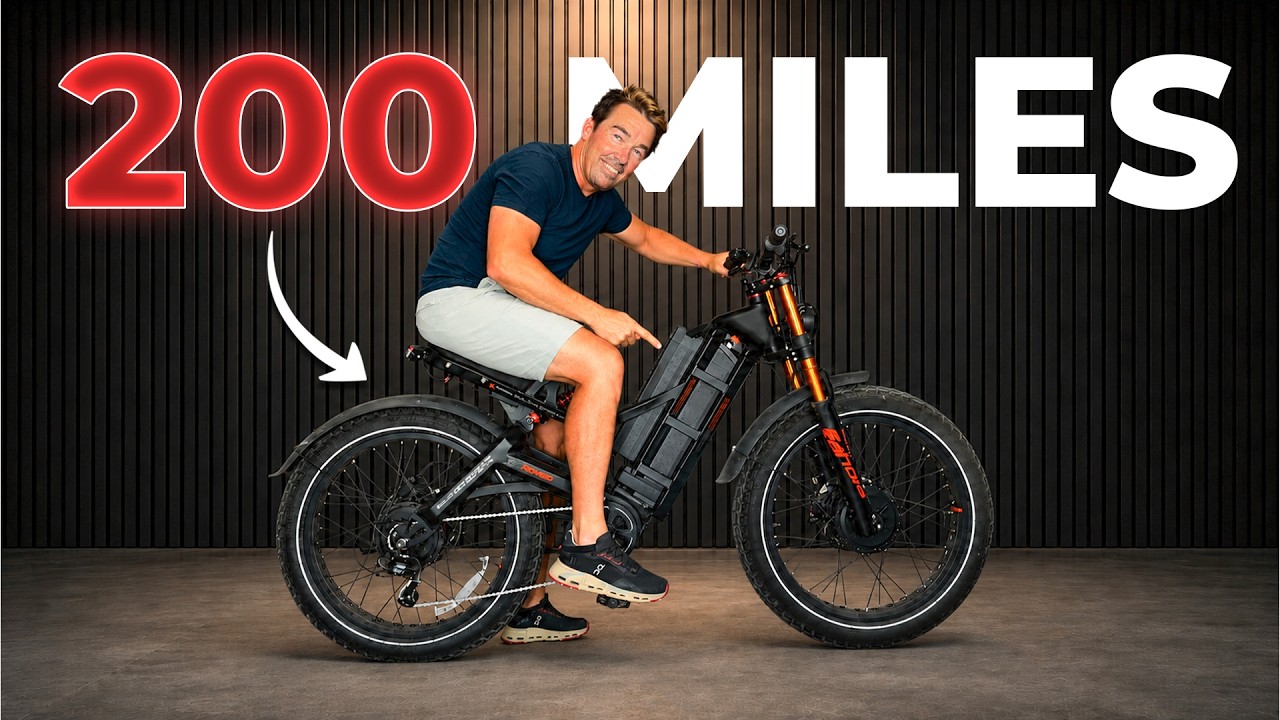
Eahora Romeo Ultra II 2026
I tested the Eahora Romeo Ultra II 2026, a massively powerful dual-motor e-bike that hits 51 mph, boasting a colossal 60V 80Ah battery that virtually eliminates range anxiety.
- Reached a verified top speed of 51 mph on flat pavement with aggressive acceleration off the line.
- Returned from a 24-mile, high-speed ride with 71 percent of the battery life still remaining.
- Crushed a 20 percent grade hill at 20 mph, treating it like it was completely flat territory.
- The 240mm hydraulic disc brakes halted this 180-pound bike from 36 mph in roughly 60 feet without skidding.
- Features highly adjustable air suspension in the front and an adjustable rear shock under the saddle.
- Weighing almost 180 pounds, it is overwhelmingly heavy and steers sluggishly at lower speeds.
- The massive battery shifts and bounces inside its cage when riding over jarring off-road bumps.
- Handlebar grips feel completely generic and arguably too basic for an e-bike in this premium tier.
- Motor
- 5,000 watts nominal with a peak of 6,000 W
- Top Speed
- 51 miles an hour
- Battery
- 60V 80 A battery
- Range
- 104 to 235 mi
- Weight
- almost 180 lb
- Weight Limit
- 500 lb
- Brakes
- Hydraulic brakes
- Rotors
- 240 mm rotor
- Hill Rating
- 45°
Eahora Romeo Ultra II 2026
Amazon · Check current price · As an affiliate we may earn from qualifying purchases.
Overview
Sometimes a product crosses my path that pushes the absolute boundaries of its category. The Eahora Romeo Ultra II 2026 is exactly that kind of machine. This is a dual-motor e-bike that can realistically keep up with cars, boasting 2500 watts in the front hum and another 2500 watts in the rear. That gives you 5,000 watts nominal with a peak output of a staggering 6,000 watts. You feel every bit of that power the second you touch the throttle.
Powering those motors is Eahora's largest battery to date. It is a completely massive 60V 80A battery that takes up the entire center cavity of the frame. It sits encased in a metal cage and even features a built-in handle, which you will absolutely need if you decide to remove it.
Out of the box, the bike is electronically limited to 28 mph to comply with standard regulations. However, diving into the advanced settings allows you to push that speed limit all the way up to 62 mph. With a high price tag tied to these premium specifications, this model is built for riders who refuse to compromise on maximum range and straight-line speed.
Real-World Performance
To see what 6,000 peak watts actually feels like on the road, I took this bike out for some rigorous testing. In speed mode one, the dual motors capped me at a comfortable 12 mph. Bumping up to mode two yielded a huge boost to 25 mph. By speed mode three, I was hitting 36 mph. When I finally opened it up in the highest settings, I reached a GPS-verified 51 miles an hour on flat pavement. The acceleration is violent in the best way possible; in just one city block, the bike rocketed from a standstill to 41 mph.
Range is just as critical as speed for a machine like this. The manufacturer claims 104 to 235 miles on pedal assist, and up to 76 miles using only the throttle. I set up a grueling test: a one-and-a-half-hour ride covering 24.87 miles with dual motors engaged in speed mode five. I maintained an average speed of 33 to 34 mph and tackled 2,484 feet of elevation gain. I returned home with an astonishing 71 percent battery life left. You can truly go fast and go far without constant range anxiety.
I also wanted to see how the motors handled steep inclines. The manufacturer rates its hill climbing ability at 45 degrees. I took it to the steepest public street in my area, which is a block-long hill with a 20 percent grade. Despite soaring ambient temperatures over 100 degrees and the bike already surviving a 45-minute ride, the dual motors ate the hill alive. I accelerated up the incline and crested the top at exactly 20 mph. It treated a 20 percent grade as if it were a flat road.
When you build a bike this heavy and fast, braking is paramount. I tested the stopping power by engaging the hydraulic brakes from 36 mph. The bike comfortably came to a complete halt just past the 60-foot mark. Impressively, I did not skid the tires, which tells me the braking power is perfectly modulated to keep such a heavy machine under control during an emergency stop.
Design & Build Quality
The frame on the Eahora Romeo Ultra II is nothing short of massive. You sit up quite high on a fixed saddle, gripping wide, mountain-bike-style handlebars. The sheer scale of this bike becomes apparent when you handle it. It weighs almost 180 pounds, which contributes to a very high 500-pound payload capacity. Because of that weight, the bike steers slowly. It has a lot of mass to turn and move, meaning you sacrifice immediate agility for high-speed stability.
The suspension system is robust enough to handle the bulk. You get adjustable, motorcycle-style air suspension up front, paired with an adjustable rear suspension setup neatly tucked underneath the saddle. Combined with the smooth yet beefy tires, the bike hops curbs and handles paved imperfections with relative ease.
However, my off-road testing revealed some distinct limitations. I took it down an uneven dirt trail heavily tracked by horses. Going over those constant jagged bumps proved rough. Because the bike is so dangerously heavy, impacts travel slowly through the entire frame. Furthermore, the massive battery is not perfectly locked down within its cage. Every time I hit a substantial bump, the battery shifted and knocked against the frame. This is strictly a pavement and smooth-gravel cruiser; I would not recommend taking it on aggressive off-road trails.
Key Features
Eahora included a gorgeous, bright LCD screen mounted dead center on the handlebars. Through this display, you can access a robust advanced settings menu by holding the plus and minus buttons. Here, you can adjust the speed limits from 1 to 62 mph, dictate exactly how much power you want delivered across the five distinct pedal assist levels, reset your trip data, change units, dim the brightness, and modify the auto-off timer up to 10 minutes. You can also engage cruise control and set a security password.
Safety features are well represented. When you first turn the bike on, it defaults to a 'park mode' where the throttle is completely dead. You have to squeeze the brake lever to disengage it, which prevents accidental launches. The hydraulic brakes feature distinct cut-off sensors, a brake fluid reservoir window, and massive 240 mm rotors.
For visibility, there is a bright headlight in the front and a tail light tucked behind the seat. Squeezing either brake lever triggers a secondary flashing light to warn traffic behind you. You also get a dedicated horn. My only major feature complaint lies with the handlebar grips; they feel extremely basic, and I have definitely felt much nicer grips on bikes within this premium price tier.
Who It's For
I highly recommend the Eahora Romeo Ultra II 2026 to riders who want to tackle long commutes at automotive speeds without breaking a sweat. If you need a payload capacity of up to 500 pounds, demand torque that flattens 20 percent grade hills, and require a battery large enough to handle 30-plus mile trips at full throttle, this is one of your best options.
Who Should Skip It
If your riding consists primarily of rugged, uneven off-road trails, absolutely skip this bike. At nearly 180 pounds, it is far too heavy to maneuver playfully in the dirt, and the battery rattling on large bumps is distracting. Furthermore, if you live in a walk-up apartment or need to load your bike onto a standard car rack, the extreme weight makes it completely impractical.
How It Stacks Up
To truly understand the scale of the Eahora Romeo Ultra II, it helps to put its specs next to a standard e-bike. During my test, I brought out the Monarch Marker for a quick visual comparison. The Monarch utilizes a very capable standard 750-watt motor that peaks around 900 watts. The Eahora dwarfs it with a peak of 6,000 watts.
This discrepancy trickles down to the components. The Monarch uses standard 180 mm brake rotors, whereas the Eahora utilizes massive 240 mm rotors just to successfully scrub off speed. Furthermore, your typical fat-tire e-bike hovers around 70 to 80 pounds. The Eahora weighs exactly 100 pounds more than that. It sits in a transitional category closer to a lightweight electric motorcycle than a traditional pedal-assist bicycle, requiring a different mindset when maneuvering and storing it.
Final Verdict
The Eahora Romeo Ultra II 2026 undeniably carries a high price tag, but it justifies the cost by delivering incredible, sustained performance. Hitting 51 mph and returning from a fast, 25-mile ride with 70 percent of my battery leftover proves its sheer capability. If you accept its immense weight and keep it off rugged trails, it is an absolute powerhouse for high-speed, long-distance riding.
How fast does the Eahora Romeo Ultra II 2026 go?
During my road testing, I reached a top speed of 51 mph on flat pavement. Through the advanced settings menu, you can actually set the board limit anywhere up to 62 mph.
What is the real-world battery range of the Eahora Romeo Ultra II?
The brand rates the 60V 80A battery at 104 to 235 miles on pedal assist, and up to 76 miles on throttle only. In my test ride, I covered 24.87 miles at an average speed of 33 mph and still had 71 percent battery life remaining.
Does the Eahora Romeo Ultra II struggle on steep hills?
Not at all. I took it up a block-long 20 percent grade hill, and the dual motors pulled me over the top at a steady 20 mph without missing a beat.
Is the Eahora Romeo Ultra II a good choice for off-road trails?
I don't recommend taking it off-road for long periods. Because it weighs almost 180 lbs, it handles very sluggishly on dirt, and the heavy battery tends to shift and rattle over large bumps.
How much rider weight can the Eahora Romeo Ultra II support?
Thanks to its massive motorcycle-style frame, this e-bike has an impressive maximum payload capacity of 500 lbs.