
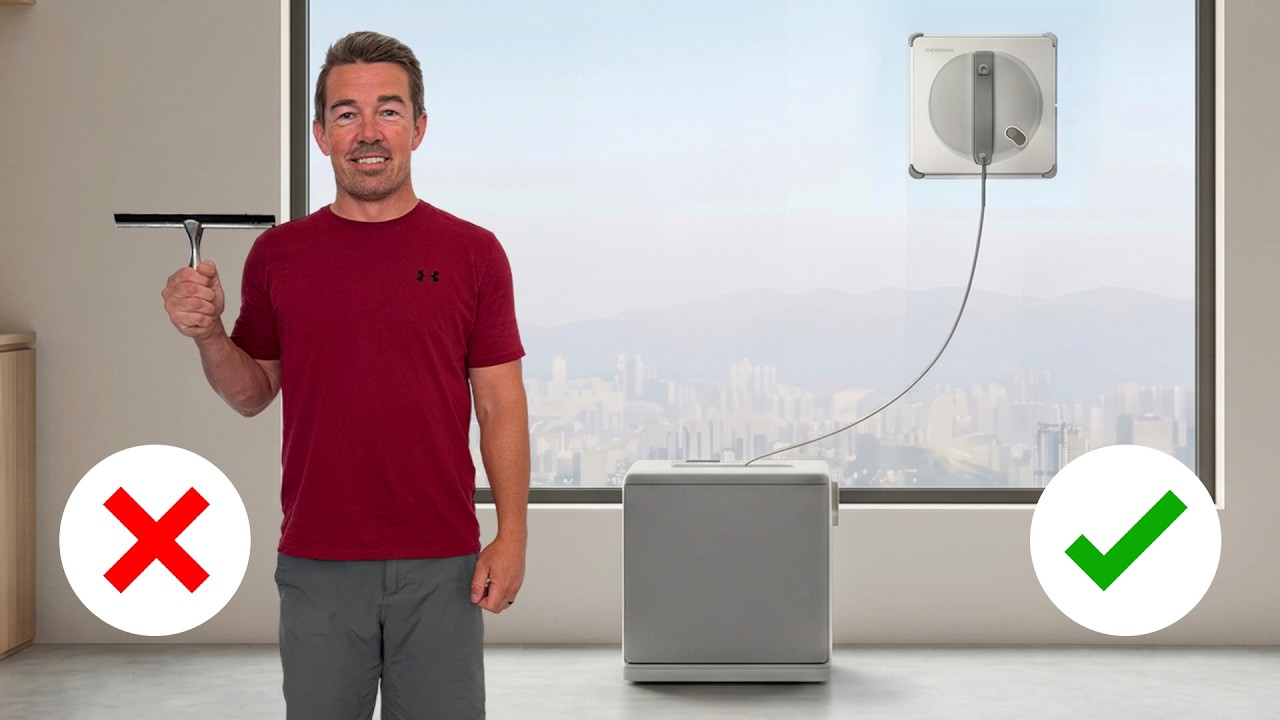
ECOVACS WINBOT W3 OMNI
The ECOVACS WINBOT W3 OMNI is an all-inclusive robot window cleaner that tackles everything from interior smudges to exterior mud, complete with a self-washing base station.
- Base station automatically washes pads with a normal or heavy-duty cycle after muddy exterior runs.
- Cord length comfortably reaches second-story windows while the base station remains secure on the ground.
- Maintains suction perfectly even when extra water is intentionally sprayed directly onto the glass.
- Included backup battery provides 30 minutes of emergency suction if the device loses power.
- Comprehensive app allows for targeted 10-second spot cleaning and intelligent zone cleaning.
- Exterior windows with shallow sills cause the robot's vacuum seal to break, forcing it to detach.
- Integrated storage compartment for the power cord is frustratingly tight and difficult to pack.
- Dual sprayers frequently overshoot the robot cleaning path by two to three inches.
- The robot can get stuck underneath poorly spaced interior window blinds during standard cleaning.
- Baked-on mud and heavy bird droppings require pre-scraping or multiple cleaning passes to fully remove.
- Nozzle Jets
- 3
- Spray Distance
- 7 in.
- Low Power Backup
- 30 minutes
- Estimated Run Time
- 3 hours and 30 minutes
- Zone Cleaning Size
- 9 and 1/2 ft or 3 m
- Spot Clean Time
- 10 seconds
ECOVACS WINBOT W3 OMNI
Amazon · Check current price · As an affiliate we may earn from qualifying purchases.
Overview
Testing the capabilities of automated home cleaning tech is always fascinating, and window robots are a particularly polarizing category. Many buyers wonder if a robot can legitimately replace a professional human window cleaner, or if it is just an expensive gimmick. To find out, we put the ECOVACS WINBOT W3 OMNI to the test across a series of rigorous indoor and exterior glass cleaning trials.
What makes the WINBOT W3 notable is its OMNI base station. Instead of just handing you a suction puck that you have to manually wet and wash, Ecovacs has built an all-inclusive system. The setup is highly reminiscent of premium robot vacuum base stations. The station houses a clean water tank, a dirty water tank, and a dedicated automated washing door to clean the mopping pads between runs. It is designed to be a complete ecosystem, keeping you from constantly running back to the sink to scrub dirty microfiber pads.
Operating the robot starts at the base station. You simply pop the pad inside the wash door to get it pre-wet and ready to go. The robot itself also features an onboard reservoir for cleaning solution, spraying the glass as it moves. At an estimated context of 500 dollars, this premium unit aims to fire your household window cleaner for good—but we had to run it through a gauntlet of mud, butter, and bird droppings to see if it actually delivers clear results.
Real-World Performance
Our testing started with a relatively standard interior job, running a Fast Clean cycle on standard indoor windows. The robot adhered perfectly and tackled the glass in about 3 minutes. While it initially left some visible wet smears, we found that simply letting the window sit for about a minute allowed the water to dry crystal clear with absolutely no residue. The everyday dust and fingerprint removal was practically flawless.
Things got drastically more complicated with a fresh kitchen disaster. After a cooking accident involving rushing burning hot butter out the door, the exterior glass was left with greasy splatters. During this particular cleanup, we noticed the robot was running perfectly dry. After holding the power button for 5 seconds to pause the unit, we discovered the onboard solution tank was entirely empty. Once refilled, the robot effortlessly erased the tough butter spill.
Exterior windows proved to be the ultimate challenge. Following a heavy mud rain, the outside glass was severely caked in grime. Using the Heavy Duty mode, the robot removed roughly 95 percent of the dirt on its first pass. However, it struggled slightly in the corners and left some smearing along the sides. A major issue arose when we attempted an edge-only test. Because the exterior windows feature a shallow sill, the robot traveled too far down, caught the lip, broke its air suction, and popped off the glass entirely. Ecovacs advises using manual remote control mode for shallow sills, but it is a distinct limitation of the automated mapping.
Heavy biological messes also tested the robot's capabilities to their limit. When dealing with baked-on bird droppings, the user manual actively recommends scraping large pieces off beforehand. We let the robot attempt it completely raw. It passed over the largest dropping three times but ended up just smearing it outward instead of lifting it safely. It successfully handled smaller droppings further down the glass by making multiple passes as it turned around, and we finished out the localized smudges using the Spot Clean function. Removing several layers of thick mud ultimately took three to four washes per window to get a streak-free finish.
Design & Build Quality
The physical footprint of the WINBOT W3 OMNI is anchored by its heavy-duty base station. It acts as both a washing hub and a secure tether for the robot, though it does have a few physical pain points. Tucking the main cable away into the rear storage compartment is a surprisingly frustrating experience. The allocated space is entirely too tight, forcing users to awkwardly jam the cords inside to get the door securely closed.
On the robot itself, Ecovacs implemented a dual-sprayer system. It features three nozzle jets that spray fluid out both the left and right sides. It safely projects the cleaning liquid about 7 inches outward to avoid hitting adjacent window panes. Unfortunately, the calibration is slightly off. We noted that the spray frequently overshoots the physical path of the robot by 2 to 3 inches, meaning it occasionally misses the fluid it just laid down.
Despite those quirks, the overarching safety and reach of the system are remarkable. Curious about its functional limits, we set up a ladder to plop the unit onto a high second-story window while remaining safely planted on the ground. The cord length was more than sufficient, allowing the robot to comfortably reach the absolute top of the upper window with an entire foot of slack remaining.
The unit features a clear sight-glass window on the robot body to manually check fluid levels, which is a genuinely helpful design touch. It is generally slim enough to navigate standard windows, but we did find that if interior blinds are installed slightly too close to the glass, the robot will get wedged behind them and become physically stuck during a run.
Key Features
The undeniable crown jewel of this system is the self-washing pad mechanism. Instead of aggressively hand-washing a filthy microfiber cloth after every glass pane, you pop it into the OMNI base station washer door. Users can choose between standard and heavy-duty wash cycles. We tested a heavy-duty wash after a completely soiled exterior run, and the pad emerged perfectly spotless while dumping incredibly nasty, mud-brown water directly into the dirty tank.
The companion app unlocks extensive granular control. You can utilize Fast, Thorough, Deep, and Heavy Duty cleaning modes. Thorough and Deep modes adjust the tracking distance, making tighter, heavily overlapping passes as the robot descends. If a window is larger than 9 and 1/2 ft or 3 m, you can set up targeted zone mapping. For stubborn messes like the residual bird droppings, users can drive the robot manually and hold a Spot Clean button that aggressively scrubs a single area for exactly 10 seconds.
Power management and fail-safes are exceptionally well thought out. Although intended to remain plugged in indefinitely for continuous whole-house cleaning, accidental power loss will not result in shattered plastic. If the power cuts out, the robot immediately drops into a low-power mode and maintains a rugged vacuum seal for 30 minutes before falling. In terms of overall runtime for the onboard components, the app displayed a fully charged estimated runtime of 3 hours and 30 minutes, which impressively only dropped by half after we cleaned half of the entire house.
Who It's For
The ECOVACS WINBOT W3 OMNI is brilliantly tailored for homeowners with large multi-story houses filled with expansive, hard-to-reach glass. If you hate climbing ladders and want the convenience of an automated station that washes its own dirty cleaning pads between runs, this system offers immense value.
Who Should Skip It
You should skip this machine if your home features predominantly shallow exterior window sills, as the robot is highly prone to losing suction and popping off when catching the narrow ledge. Additionally, it is not a magical fix for years of neglected, baked-on grime; if you refuse to manually pre-scrape thick bird droppings, this robot will leave you frustrated with smeared glass.
How It Stacks Up
While explicit competitors were not directly named during testing, placing the WINBOT W3 OMNI against the broader window robot market highlights its unique positioning. Most entry-level window cleaners are simple suction pucks requiring massive manual intervention—you have to spray the glass yourself, peel off filthy pads, and rigorously hand-wash them at the sink. By incorporating an automated cleaning station with dual dirty and clean water tanks, Ecovacs drastically elevates the category, shifting window maintenance into a tightly integrated home tech ecosystem.
Final Verdict
The ECOVACS WINBOT W3 OMNI is an impressive piece of utility engineering that legitimately minimizes the danger and hassle of second-story window maintenance. While it struggles with tight sills and requires a few extra passes to defeat severe mud, its fully integrated self-washing base station and long safety tether are game-changing conveniences. At a roughly 500-dollar price that could potentially replace recurring professional cleaning services, it strikes an excellent balance of safety, app features, and daily cleaning power.
Does the Ecovacs Winbot W3 Omni work on second-story windows?
Yes. The included tether cord is long enough to safely reach second-story windows while the base station remains securely on the ground.
What happens if the Winbot W3 Omni loses power?
It actively switches to a low power mode that expertly maintains its vacuum suction to the window for 30 minutes, preventing an immediate fall.
Can the Winbot W3 Omni clean bird poop?
Yes, though Ecovacs highly recommends scraping larger baked-on pieces first. Without scraping, the robot may temporarily smear the mess and require multiple heavy-duty passes.
Does the Ecovacs Winbot W3 Omni clean its own pads?
Yes. The OMNI base station features a dedicated washer door that runs both normal and heavy-duty self-cleaning cycles for the mopping pads.
Will the Winbot W3 Omni clean right up to the window edges?
It provides crisp edge cleaning on standard interior frames, but exterior windows with shallow sills can cause the robot to travel too far down, breaking its required air suction.