
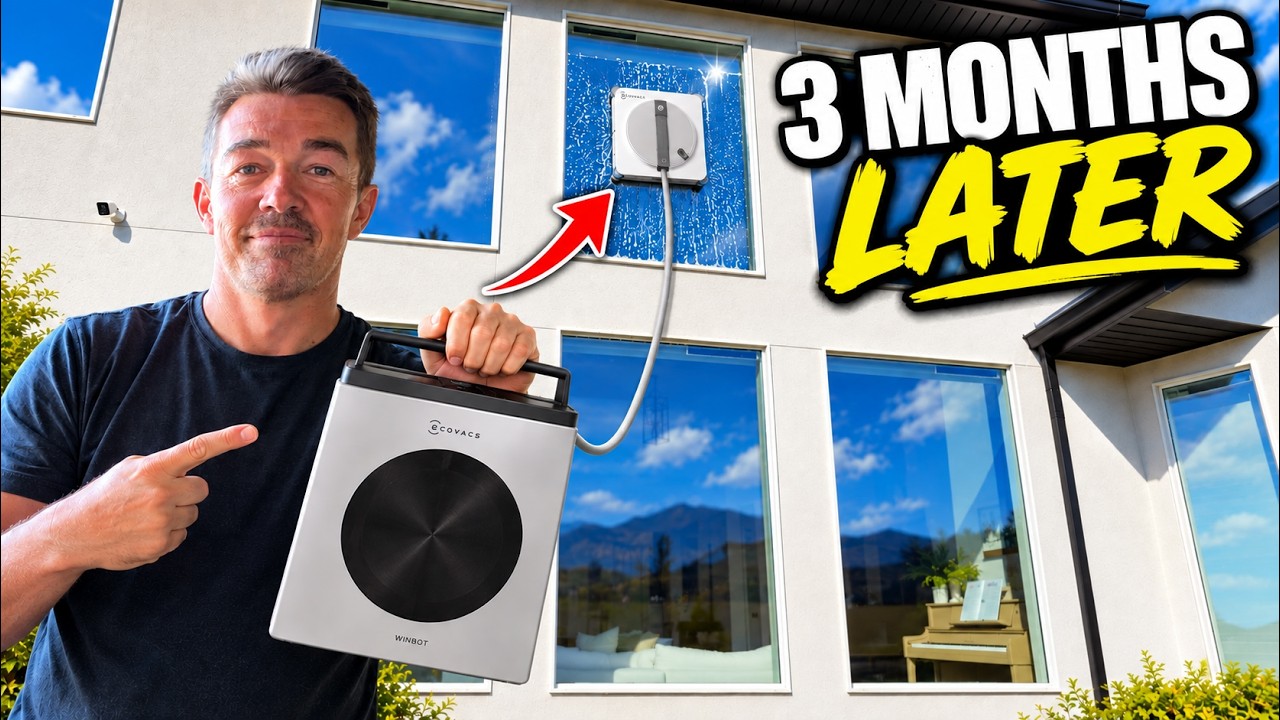
ECOVACS WINBOT W3 OMNI
After three months of testing the ECOVACS WINBOT W3 OMNI, I can finally ditch the heavy ladder and let this 8,000 Pa robot tackle my highest outdoor windows.
- Allowed me to weed my strawberry patch while it independently washed my high outdoor windows.
- Base station features a built-in battery that provided roughly 3 hours of runtime off the grid.
- Strong 8,000 Pa suction held firm even when I gave the robot a solid tug on the glass.
- Base station includes an internal self-washing cycle to scrub and re-wet the mop pad.
- Tackled a heavily soiled basement window perfectly, removing a thick layer of dust in one pass.
- Lacks an extension pole, meaning I still had to drag out a ladder just to place it on my 20-foot windows.
- Required three cleaning cycles on heavy duty mode to get my large backyard glass looking its best.
- Hot and windy weather dried out the mop pad too quickly, requiring frequent trips to the base station for re-wetting.
- Left a slight residue smear where it finished, which required a quick manual wipe down with a rag.
- Occasionally got stuck and triggered a 'lost suction' error, requiring me to hold the power button to restart it.
- The power cord occasionally gets twisted up when dispensing from the base station.
- MSRP
- $699.99
- Suction (Pa)
- 8,000 pascals
- Runtime
- 3 hours
- Reserve Battery
- half an hour
- Safety System
- 12 safety system
ECOVACS WINBOT W3 OMNI
Amazon · Check current price · As an affiliate we may earn from qualifying purchases.
Overview
I have been using the ECOVACS WINBOT W3 OMNI window cleaner for over 3 months, and I wanted to find out if it is actually worth the investment or just another robot gimmick. Before this robot arrived, I was not exactly a Windex and towel kind of guy because traditional sprays just leave streaks everywhere. My old setup involved a squeegee, a bucket of water, a yellow glove, and a Little Giant ladder that feels anything but little when you are lugging its weight around the yard.
The setup alone was always a painful, physical process. I had to put my tool belts on, set up the heavy ladder, wet my glove, and carefully climb up. With my larger backyard windows, I could only wash half the glass at a time before having to climb down, move the ladder, and repeat the process. Because of that agonizing routine, I just did not clean them very often.
Those backyard windows are a good 20 feet up in the air. Instead of doing them myself, I actually resorted to hiring a professional company to come do them for me. They are not cheap. It costs me roughly $600 to have someone come wash my windows 4 times a year. At a regular retail price of $699.99, the WINBOT W3 OMNI costs just a little more than a single year of professional cleanings, making it a very interesting alternative.
Real-World Performance
When it comes to actual cleaning power, I was genuinely surprised by how well this robot performs. To really push it, I took it down to my basement window. The outside of that glass was incredibly dirty, covered in a thick layer of nasty dust that I could literally draw on with my finger. After just one cleaning pass, all that caked-on dust was completely gone, leaving a crystal-clear line between the washed and unwashed sides of the glass.
For my massive backyard windows, I found that the robot does a pretty good job, though it requires a bit of patience. Over the last 3 months, I realized that these large panels look much better if I run 3 separate cycles on them. I simply let it finish, open the app, select heavy duty mode, and send it out again. It is not quite as flawless as a professional manual cleaning, but it is definitely good enough to where I am okay letting a robot handle the chore.
Weather plays a massive role in how well this device functions. If you have a house with south-facing windows like I do, and the sun is out on a windy day, the mop pad tends to get dry very quickly. A dry mop pad is simply not going to clean your window, even though the robot actively sprays out cleaning solution from both sides as it moves. When it is hot and windy, you absolutely have to monitor the pad moisture.
I also discovered a slight imperfection in the cleaning process that the brand does not warn you about. When the robot finishes and I remove it from the glass, there is often a little bit of residue or smearing left over right at the removal spot. I just take a rag and do a quick manual wipe down. It is a small extra step, but it makes the final result look a lot better.
Design & Build Quality
The overall build and portability of this system make it incredibly easy to live with. Everything you need to wash your windows is contained right in the base station. You just grab the handle, carry the station to the next window, and set it down. It is a lot cleaner and easier than carrying a sloshing bucket and a metal ladder around the perimeter of my house.
That base station is also surprisingly clever. When you fold the carrying handle down, suction cups on the bottom engage to make the station stick securely to the surface you set it on. If you lift the handle back up, it releases so you can easily move it. For extra peace of mind, there is a safety harness connection in the back near the cord, allowing you to attach it to a secure anchor point as a physical backup.
The robot itself is robust and generates a massive 8,000 pascals of suction pressure. I was initially worried about my kids messing with it while it worked. To test it, I gave the robot a pretty good tug while it was on the glass, and it stayed firmly stuck. You do have to manage the tether, though. When you hit the button to drop the cord, it sometimes gets a little twisted, requiring you to play around with it to get it properly unwound.
One major design flaw I experienced involves high window placement. I have three upper windows that I cannot reach from the ground. I really wish this robot had some sort of extension pole attachment to raise it up and place it on the glass. Because it lacks one, I still have to drag out that heavy ladder just to stick the robot onto the top windows, which defeats a bit of the convenience.
Key Features
The absolute best feature is the built-in battery inside the base station. On the side of my house, I have zero outdoor outlets. Fortunately, you do not need one to run this system. The screen on the base station clearly showed I had 3 hours of battery life remaining, which was plenty of time to clean those side windows and pretty much the rest of my house. If you do have a ton of windows, you still have the option to plug it directly into a wall outlet.
The self-cleaning function inside the base station is another standout feature. When the mop pad gets dry or dirty, you turn the robot over, pull your fingers through four holes to release the pad, and open a door on the station. Inside, there are scrubbing brushes that wash and re-wet the pad. You can choose between a standard wash or a heavy duty wash, hit play, and let the station prep the pad for the next window.
The app connectivity provides excellent control and convenience. You can manually remote control the robot, which was incredibly useful when the robot finished a cycle on the far side of a top skinny window. I just opened the app, steered it over to the side where my ladder was positioned, grabbed it, and easily moved it to the next pane.
Safety features are heavily integrated into the software. Ecovacs calls it a 12 safety system. Every now and again, the robot gets stuck, freezes, and triggers a 'lost suction' voice prompt. When this happens, or if it loses main power, it goes into a reserve battery mode that provides enough power to stay suctioned to the window for 30 minutes. The base station sounds an alarm, and you immediately get a notification sent to your phone.
Who It's For
I would highly recommend the WINBOT W3 OMNI to homeowners who have large, numerous, or hard-to-reach windows that require constant ladder work. It is a fantastic tool for people who love to multitask. In the time it took the robot to clean three large windows, I was able to completely weed and loosen the soil in my strawberry patch, effectively getting two chores done at once.
Who Should Skip It
If you live in a smaller home with ground-level windows that are easy to wipe down in a few minutes, you should skip this. The initial setup, occasional cord twisting, and need for manual residue wipe-downs mean it is overkill for quick jobs. It is also not ideal if you expect absolute, streak-free perfection on the very first pass without being willing to run multiple cycles.
How It Stacks Up
Because I have mostly relied on professional window washers or my own manual labor up until now, I do not have a fleet of window robots to compare this against directly. However, against the traditional squeegee and bucket method, the WINBOT is infinitely more convenient.
Washing all my outside windows manually takes me about an hour and a half to two hours of sweaty, physical labor on a ladder. The robot gets the entire house done in about an hour. While a professional crew costing $600 a year might get the glass slightly cleaner on the first try without needing multiple cycles, this robot easily pays for itself in just over a year and saves me from risking a dangerous fall.
Final Verdict
After 3 months of heavy real-world use, I can confidently say that the ECOVACS WINBOT W3 OMNI is absolutely worth it. Me not having to balance on a ladder to manually clean massive windows is a beautiful thing. It tackles incredibly dirty glass with ease, features a brilliant built-in battery for off-grid cleaning, and lets me stand safely on the ground while it works.
At $699.99, the price tag is steep, and I do really wish it came with an extension pole for those truly out-of-reach spots. However, the sheer amount of time it saves and the ability to multitask in the yard while it cleans makes it a permanent replacement for my old squeegee and bucket. If you hate climbing ladders as much as I do, this robot will genuinely make your weekend chores much easier.
Does the ECOVACS WINBOT W3 OMNI need to be plugged into an outlet to work?
No, it does not need an outlet because the base station has a built-in battery. In my testing, the screen indicated I had 3 hours of runtime, which is enough to do my whole house off the grid.
Will the ECOVACS WINBOT fall off the window if the power goes out?
No, the robot features a reserve battery mode that kicks in if it loses main power. This reserve provides enough power to keep it suctioned to the glass for half an hour, and the base station also includes a safety harness you can attach as a physical backup.
How well does the ECOVACS WINBOT clean very dirty windows?
It handles heavy dirt exceptionally well. I tested it on a basement window covered in a thick layer of dust, and one pass cleared it entirely, though for larger windows I recommend running three cycles on heavy duty mode.
Can you control the ECOVACS WINBOT with your phone?
Yes, you can use the companion app to manually remote control the robot's movements. This is incredibly helpful for steering the robot back to a spot where you can easily reach it from a ladder when the cleaning cycle is done.
How much suction power does the ECOVACS WINBOT W3 OMNI have?
The robot produces 8,000 pascals of suction pressure to stay attached to the glass. During my tests, I gave it a solid tug while it was running, and it stayed firmly stuck to the window without budging.