
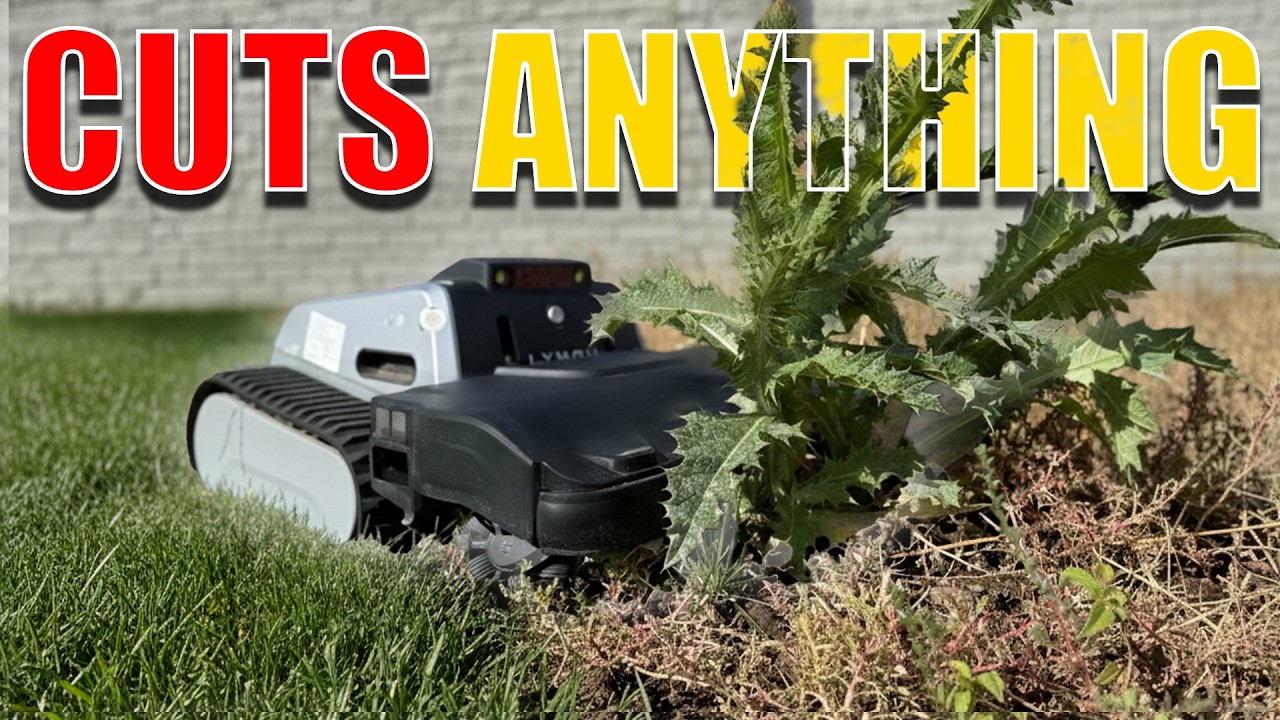
Lymow Robot One
I spent two weeks testing the Lymow Robot One, and its ability to climb 6-inch rocks and leave a flawless checkerboard pattern in overgrown grass absolutely blew me away.
- Crawled over 6-inch rocks and uneven cement slabs without getting permanently stuck in my testing.
- Flawlessly mulched incredibly long grass leaving no visible clippings behind.
- App mapping is a breeze since you only have to drive the perimeter, and it automatically connects zones.
- The 'spellcheck' app feature perfectly remembered and returned to spots missed after it got tangled in my hose.
- Extremely zippy at its max speed of 3 feet per second, making manual RC driving genuinely fun.
- Burned through a full battery and required a mid-job recharge for my backyard when using max blade speed and heavy overlap.
- Clogged up and temporarily shut down when I combined overgrown grass with the absolute lowest blade setting.
- Initial perimeter passes didn't get as close to my fence as I wanted, requiring manual app adjustments.
- Got caught on a garden hose I left out, requiring me to physically rescue and relocate it.
- Top Speed
- 1 foot per second up to 3 feet per second
- Cut Height
- 1.18 inches up to 3.74 inches
- Cut Width
- 16-inch cutting swath
- Slope Rating
- up to a 45% grade
- Max Coverage
- mow up to 1.73 acres in 12 hours
- Range
- just over a half an acre on a single charge
- Battery Life Cycle
- charge it up to 2500 times
- Charge Time
- 90 minutes (with fast charger)
Lymow Robot One
Amazon · Check current price · As an affiliate we may earn from qualifying purchases.
Overview
This is the Lymow Robot One, and I spent the last two weeks playing around with it to see if it can really do what the company claims. Let me just tell you right up front: it can do much, much more. I wanted to see how it handled extreme obstacles, deep grass, and complex yards, and it absolutely delivered. It cuts grass better than I do manually, leaving a stunning checkerboard pattern that instantly upgrades the look of my yard.
Setting this mower up is surprisingly easy, completely avoiding the nightmare of burying perimeter wires. The Lymow Robot One uses an RTK reference station to track its location. I chose a flat area in my yard, secured the charging station with the four included ground stakes, and installed the RTK antenna on the ground. The kit also includes longer cords and mounting gear if you prefer to install the antenna on a wall or roof.
Once the hardware was dialed in, I opened the app to create a zone. You simply use the dual on-screen controllers to drive the mower around the outside of your yard—it doesn't even need to be cutting while you map. I mapped the front yard, then the backyard, linked the two zones together, and drove it back to the dock. Boom. Ready to mow.
Real-World Performance
When it came time to actually cut, I put the Lymow Robot One through the wringer. I had been a little lazy over the previous weeks, so my grass was exceptionally long and thick. To make matters worse, I mistakenly set the blade to its lowest setting. That brutal combination caused the mower to temporarily clog up and stop. However, I was seriously impressed when it recognized the jam, shut down the blades, backed up on its own, and restarted itself without me having to intervene. Once it got moving, it just mulched that overgrown grass away, turning on a dime.
The obstacle testing was where things got really fun. Lymow claims it can climb a 2-inch obstacle, but I wanted to push the limits. It easily crawled over 2x4s and pushed its way over a 4-inch obstacle. It finally met its match against a solid 6-inch wall, acting like it hit a brick wall, but then I tested it on 6-inch rocks. It got high-centered a few times but cleverly figured it out and kept going.
Next, I took it to a steep pile of cement slabs since Lymow claims it can handle up to a 45% grade. It charged right up the first slab and made it onto the ledge of the second before losing traction. It is built like a rugged RC car, and seeing it tackle terrain like that was amazing.
Design & Build Quality
The physical design of this mower is built around being rugged, nimble, and highly efficient. When it is moving across the lawn, it is incredibly zippy. It can turn on a dime and maneuvers tight spaces effortlessly. I noticed early on that the mulching blades are remarkably well-designed. Even though my backyard grass was crazy long, there were zero visible clippings left behind after the second pass. It just chewed up the grass and fed it right back into the turf with strong grass cannibalism.
It also features a generous 16-inch cutting swath, which helps it cover ground quickly. Build quality extends beyond just the hardware to the digital safety net as well; it features a built-in anti-theft geofence. If someone tries to pick up your precious mower and carry it outside the invisible boundary, you immediately get a notification on your phone.
Even the charging dock aesthetic is solid. The mower looks incredibly cool parked at its station at night with its lights glowing, catching my eye enough that I had to go outside just to take a picture of it.
Key Features
The Lymow app is absolutely packed with features that let you fine-tune exactly how the machine behaves. You can adjust the travel speed from a leisurely 1 foot per second all the way up to an aggressive 3 feet per second. When you crank it to max, it is genuinely fast and incredibly fun to drive manually—for parents it is a lawn tool, but it feels like a high-end RC car. You can also dial in the blade height anywhere from 1.18 inches up to 3.74 inches, change the actual speed of the spinning blades, and adjust the angle of the cut.
One of my absolute favorite features is what I call the lawn spellcheck. In my backyard, the mower accidentally ran over a garden hose I left out and got stuck. I had to go outside, free it, and manually place it back on the grass. Looking at the app, I saw a visual map of the missed strips where it got tangled. When the mower made its cross-pattern pass later, it specifically went back and perfectly cleaned up every single spot it missed.
Finally, the active time scheduling is a lifesaver. I set mine to run strictly between 8:00 AM and 9:00 PM. If it hits 9:00 PM mid-job, it just goes home to charge and resumes right where it left off the next morning at 8:00 AM.
Who It's For
I highly recommend the Lymow Robot One for tech-forward homeowners who want a perfectly manicured lawn without spending their weekends doing manual labor. It is especially ideal for properties with uneven terrain, steep hills, or yards scattered with obstacles like tree roots or rocks. If you enjoy geeking out over app customizations, granular settings, and beautiful checkerboard mowing patterns, this machine is right up your alley.
Who Should Skip It
If you have an incredibly simple, small, flat yard and don't care about smart features, this rugged machine is likely overkill for your needs. Also, if you expect the mower to cut a massive, overgrown yard on the maximum blade speed, lowest height, and tightest overlap settings without needing a mid-job battery recharge, you might find yourself waiting on the dock.
How It Stacks Up
Compared to the older generation of robotic lawn mowers that require you to spend a weekend on your hands and knees burying a physical perimeter wire, the RTK mapping on the Lymow Robot One feels like stepping into the future. You aren't permanently tethered to a physical layout; if you add a new garden bed, you just redraw the digital boundary in your app.
When you put it up against basic bump-and-turn mowers that wander aimlessly like a cheap robot vacuum, the Lymow's systematic relative chessboard pattern is on another level. It doesn't just bump and bounce; it purposefully navigates, actively avoids obstacles by stopping a foot away, and leaves clean, satisfying lines. Plus, its sheer climbing power over rocks and cement slabs sets it apart from competitors that get permanently stranded the second they hit a raised sidewalk edge.
Final Verdict
At the end of the day, the Lymow Robot One completely exceeded my expectations. It powers through heavy brush, climbs over ridiculous obstacles, and manages complex boundary mapping with ease. My yards equal about a fifth of an acre, and mowing manually takes me an hour every single week. Living in Utah with a 40-week mowing season, that is 40 hours of my life saved every year—basically a whole week-long trip to Hawaii reclaimed.
Multiply that by five years, and it is 200 hours of free time handed right back to me. While I did have to rescue it from a rogue garden hose, and the battery drains quickly on max settings, the impeccable cut quality and smart recovery features more than make up for it. I wholeheartedly recommend it to anyone looking to automate their yard work and reclaim their weekends.
Can the Lymow Robot One climb hills and rocks?
Yes, Lymow says it can handle up to a 45% grade. In my testing, it successfully crawled over 6-inch rocks and managed to climb up a pile of uneven cement slabs.
Does the Lymow Robot One require a boundary wire?
No. It uses an RTK reference station that you can install on the ground or your roof, and you simply map your yard by driving the mower around the perimeter using the mobile app.
How well does the Lymow Robot One handle long grass?
It powers through long grass effortlessly and leaves virtually no clippings behind thanks to its mulching blades. However, setting the blade to its absolute lowest height in deeply overgrown grass can cause it to temporarily clog.
What happens when the Lymow Robot One runs out of battery?
When the battery hits 15%, the mower automatically stops the current job and drives itself back to the charging station. Once recharged, it resumes exactly where it left off.
Can I set a mowing schedule for the Lymow Robot One?
Yes. The app features an active time setting where you can restrict mowing strictly between specific hours, like 8:00 AM to 9:00 PM, to prevent it from mowing at night.