
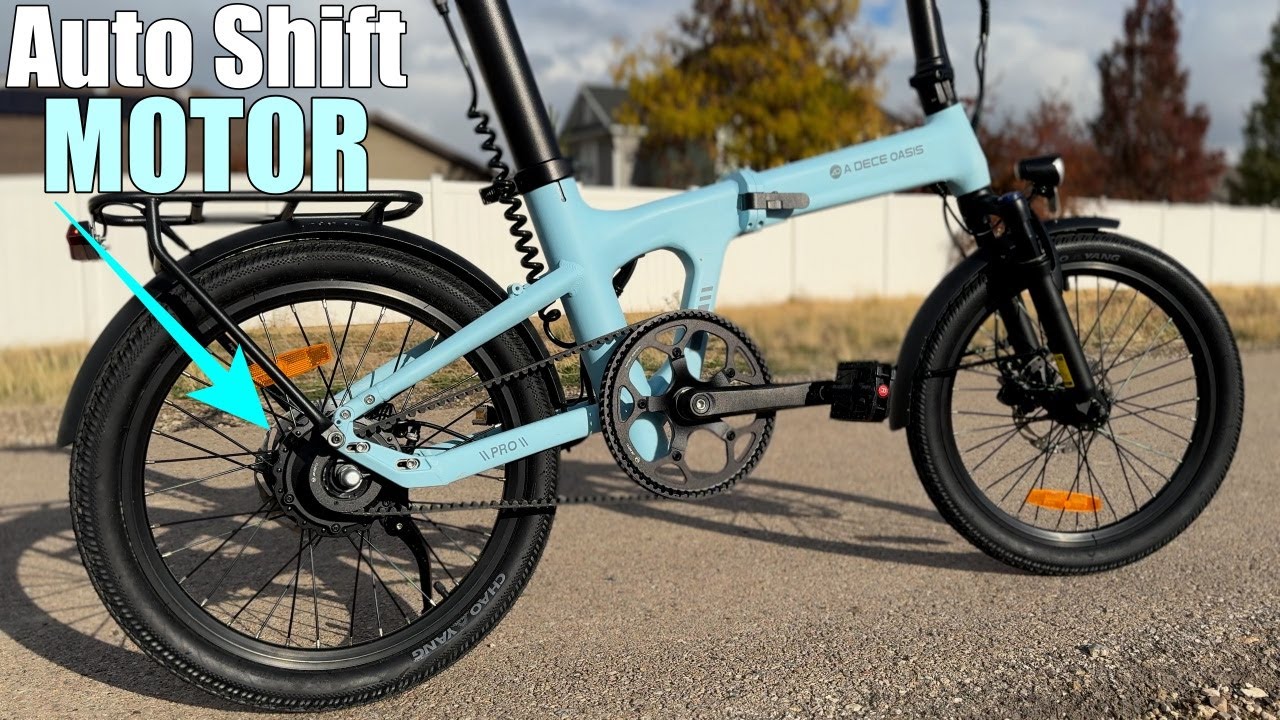
ADO Air 20 Pro
The ADO Air 20 Pro pairs an auto-shift motor with dual torque sensors for the most intuitive, seamless pedal-assist ride I've ever tested.
- Auto-shift motor changes gears seamlessly after exactly eight pedal revolutions.
- Dual torque sensors provide near-instant motor engagement the second I put pressure on the pedals.
- Gates carbon belt drive keeps things clean and requires minimal maintenance.
- Weighs just 39 lbs and includes a magnetic closure for easy folding and transport.
- Front fork suspension combined with hydraulic brakes made for a comfortable, controlled ride on trails.
- Tops out at a very slow 15.5 mph in the highest assist setting.
- The grooved saddle is quite hard and uncomfortable.
- The color LCD screen gets incredibly dim when the headlight is turned on.
- The turn signal switch feels cheap and doesn't display on the main screen.
- Motor
- 250 W
- Battery
- 36V 9.6 amp
- Range
- 62 miles
- Top Speed
- 15.5 mph
- Charge Time
- 4 to 6 hours
- Weight
- 39 lbs
- Weight Limit
- 264 lb
- Brakes
- Tetro hydraulic brakes
- Tires
- shayy Yang street tires
- Warranty
- 1-year warranty
- MSRP
- $1,985
ADO Air 20 Pro
Amazon · Check current price · As an affiliate we may earn from qualifying purchases.
Overview
Back in 2023, ADO put themselves on the map with a wildly successful Indiegogo campaign for their a20 e-bike, raising over $600,000. Now, I have my hands on the upgraded version, the ADO Air 20 Pro. This is not your standard lightweight foldable e-bike. It is a highly specialized, premium commuter built around a Gates carbon belt drive system, dual torque sensors, and an incredibly unique auto-shift motor.
Priced at $1,985, it is undeniably a unique price for a unique bike. The frame is beautifully crafted, and ADO includes a one-year warranty along with free shipping. But what really makes this bike stand apart from the crowd is the complete lack of a traditional shifter or derailleur. It operates visually as a single-speed bike, with all the shifting magic happening automatically inside the rear hub.
Going into my testing, I was incredibly curious about how an auto-shift motor would actually feel out on the road. After putting it through its paces, I can say it provides one of the most intuitive riding experiences I have ever had. The learning curve is virtually non-existent, making it an incredibly compelling option for riders who just want to hop on, pedal, and go.
Real-World Performance
If you are looking for raw power, I need to stop you right here. The ADO Air 20 Pro is equipped with a modest 250W rear hub motor, and its speed is strictly capped. When I set the bike to the highest pedal assist level on Sport mode, it topped out at a yawn-inducing 15.5 mph. If you switch over to Eco mode and leave it on pedal assist level three, the bike becomes even slower, topping out at just 10 mph. Clearly, ADO did not focus on high-speed thrills.
However, what it lacked in top speed, it made up for with sheer intuitive control. The dual torque sensors—one on each side—make the motor reaction time completely instantaneous. As soon as I put pressure on the pedals, the bike goes. I have never seen a hub motor bike react this quickly.
The auto-shift motor is the absolute star of the show. When I come to a complete stop, the motor senses it and automatically drops into a low gear, making it super easy to get going again. After exactly eight pedal revolutions, I can feel the motor seamlessly shift up in gear. You cannot hear it happen because everything is completely silent, but you feel the resistance change as if you just shifted into seventh or eighth gear on a traditional bike.
I also took the bike on a trail to test out its climbing power and ride feel. Between the auto-shift motor and those ultra-responsive dual torque sensors, it actually climbs surprisingly well. Pushing it up a local dirt path with a decent incline was a breeze. There is practically zero noise coming from the motor, making for a highly serene ride.
Design & Build Quality
The frame design on the ADO Air 20 Pro is exceptionally clean. One detail I immediately noticed is the complete lack of welding scars where the main frame folds. While there are a few visible welds on the rear fork, the main body of the bike is beautifully smooth. The wiring is routed internally just behind the head tube, keeping the cockpit looking tidy.
Portability is a massive selling point here. The bike weighs a very manageable 39 lbs, making it relatively easy to lift. It folds down like most folding bikes: the handlebars fold down, the saddle drops, the pedals fold up, the kickstand goes up, and the frame bends in half. ADO cleverly included a magnet to hold the two halves together once folded, which keeps it from flopping around while you carry it.
For rolling stock, it sits on street tires that are just slightly less than two inches wide. When I hit bumps on my test trail, the front fork suspension handled them beautifully. It is a lockable suspension fork, and paired with the softer tires, the overall ride is quite comfortable. Stopping power is handled by hydraulic brakes, which felt solid and reliable throughout my test ride.
My only real complaint about the ergonomics is the saddle. It is a basic seat with a groove down the middle, and to be completely honest, it is quite hard. If I were keeping this bike for daily commuting, I would swap that saddle out immediately. The riding posture, however, is highly adjustable. ADO claims the bike fits riders from 4 foot 9 all the way up to 6 foot 5. At 5 foot 11, I found the cockpit spacious and enjoyed a nice upright posture with a slight bend in my knee.
Key Features
Because this is a pedal-assist-only bike—there is no throttle whatsoever—the electronics are focused heavily on customizing your pedaling experience. You get a color LCD screen on the handlebars, but I immediately noticed a frustrating flaw. Whenever I turned on the headlight, the screen became incredibly dim, making it hard to read in daylight.
Through the screen, you can adjust settings by holding down the plus and minus buttons. You can toggle auto power off, screen brightness, and choose between Eco and Sport modes. Between the three assist levels in Eco and the three in Sport, you get a total of six different riding modes. You can also dive into advanced settings via the ADO smartphone app, which connects seamlessly to the bike.
The battery is hidden inside the seat post. It is a 36V 9.6 amp unit that ADO claims can deliver up to 62 miles of range. You charge it via a port located right behind the saddle, and it takes about four to six hours to fully recharge. I love seat post batteries for stealth, but you do have to take the whole post inside if you want to charge it away from the bike.
Rounding out the features, ADO included a flick bell, aluminum fenders, and turn signals. The turn signal switch on the handlebar feels a bit cheap, and the signals only flash on the tail light—they do not show up on the LCD screen, and you have to manually center the switch to turn them off. Finally, the Gates carbon belt drive is fantastic. It requires zero grease, lasts longer than a chain, and keeps your pant legs completely clean on a commute.
Who It's For
I would point commuters who want a clean, low-maintenance, and ultra-portable e-bike toward the ADO Air 20 Pro. The Gates carbon belt drive keeps grease off your pants, the 39-pound weight makes it easy to carry into an office, and the auto-shifting motor creates the most effortless, intuitive pedaling experience I have ever tested.
Who Should Skip It
If you are looking for speed, thrills, or lazy rides, skip this bike. With a top speed of just 15.5 mph and absolutely no throttle, this is strictly a pedal-assist cruiser for folks who do not mind taking their time.
How It Stacks Up
Since I did not test this alongside another specific model today, I will compare it to the broader $2,000 folding e-bike segment. At this price point, you typically expect higher-end components, and the ADO Air 20 Pro largely delivers with its hydraulic brakes, Gates belt drive, and lockable front suspension. Most bikes in this category only offer a single torque sensor and standard chain drivetrains. By including dual torque sensors and an auto-shift hub, ADO provides a far more refined and responsive pedaling experience than most of its direct competitors, even if it severely lags behind them in top speed.
Final Verdict
The ADO Air 20 Pro is a masterclass in intuitive, smooth riding. The combination of the auto-shift motor and dual torque sensors makes it feel like an extension of your own legs. While the hard saddle and dim screen are minor annoyances, the clean belt drive and lightweight folding frame make it an exceptional daily commuter. At $1,985, it is not cheap, and it is certainly not fast, but it is one of the most uniquely satisfying pedal-assist bikes I have ever ridden.
How fast does the ADO Air 20 Pro go?
The ADO Air 20 Pro tops out at 15.5 mph on the highest pedal assist level in Sport mode, and 10 mph in Eco mode.
Does the ADO Air 20 Pro have a throttle?
No, there is no throttle on this bike. It is strictly a pedal-assist e-bike.
How long does the battery last on the ADO Air 20 Pro?
The 36V 9.6 amp seat post battery takes 4 to 6 hours to recharge and offers a claimed range of up to 62 miles.
How much does the ADO Air 20 Pro weigh?
The bike weighs a very manageable 39 lbs, making it relatively lightweight for a folding e-bike.
How does the auto-shift motor work on the ADO Air 20 Pro?
The motor senses when you stop and drops into a low gear. After eight pedal revolutions, it automatically and silently shifts up into a higher gear.