
Ascentiz HUltra Exoskeleton
I walked six miles, climbed over 200 stairs, and carried 40 pounds up a steep hill to test the Ascentiz HUltra Exoskeleton, and I am shocked by how much time and physical effort it actually saved me.
- Cut 1 minute and 6 seconds off my time climbing 234 stairs.
- Boosted my average hiking speed from 2.5 mph to 2.8 mph over a 3-mile mountain loop.
- Delivers 1,000 watts of peak power that made carrying a 40-pound weight up a steep hill noticeably easier.
- AI mode impressively recognized the difference between small and large steps to dynamically adjust motor power in 20 milliseconds.
- Battery doubles as a portable power bank and fully recharges in just 65 minutes.
- Sitting down and standing up confuses the AI, causing an awkward teeter-totter power shift instead of steady assistance.
- Highest power mode drained the battery down to roughly 30 percent after just 3 miles of hiking.
- Train mode actively pulls your legs backward to create resistance, which I did not enjoy using.
- Taking the 5.5-pound rig off leaves your natural legs feeling incredibly heavy, like you are wearing sandbags.
- Motor
- 1,000 watts of peak power
- Weight
- 5.5 lb
- Range
- 15 1/2 m
- Charge Time
- 65 minutes
Ascentiz HUltra Exoskeleton
Amazon · Check current price · As an affiliate we may earn from qualifying purchases.
Overview
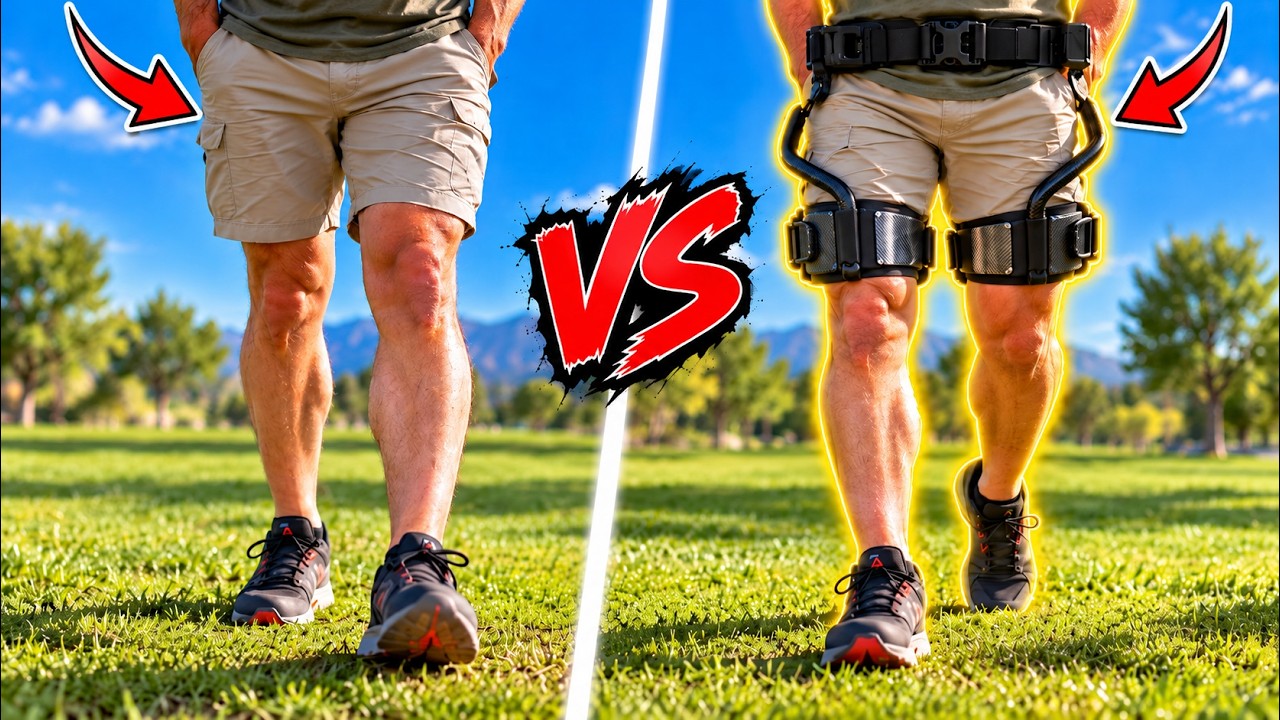
I strapped the Ascentiz HUltra Exoskeleton to my legs and put it through a grueling series of physical tests to find out if wearable robotics actually make a measurable difference for everyday hikers. To find out, I climbed over two hundred stairs, walked six miles, and carried a forty-pound weight up a very steep hill. You wear this rig exactly like a padded belt, strap it down securely to each leg, and let the dual electric motors do the heavy lifting for you. There is a motor mounted on each side, and both are rated for 500 watts of peak power. Combined, that gives you 1,000 watts of peak power designed specifically to push you up steep hills and towering staircases.
The entire setup weighs exactly 5.5 pounds, which might sound like a lot of bulk to strap to your lower body before a hike. However, the motors completely offset that weight while the system is powered on and in use. It comes with a companion smartphone app for adjusting settings, but you can also control the device directly. You simply hit the main power button and use the plus and minus buttons to click through the five primary power levels right from the belt itself.
Real-World Performance
To see exactly how much time and energy these motorized legs could save me, I found a massive outdoor staircase featuring exactly 234 steps. Walking up and back down unassisted took me 6 minutes and 56 seconds of pure misery, leaving me completely winded. After resting for about ten minutes, I put the exoskeleton into AI mode and did the exact same punishing climb. The motors pulled my legs up aggressively with every single step, cutting my total time down to 5 minutes and 50 seconds. I was still breathing heavily by the time I reached the top, but the 1 minute and 6 seconds I saved was undeniable proof that the motors work.
Next, I drove up to the mountains to conduct a rigorous 3-mile range and speed test. Without the legs on, my average hiking speed over the rough terrain was 2.5 miles per hour, and I finished the loop in 1 hour and 12 minutes. With the exoskeleton activated on its highest setting, my average speed noticeably jumped to 2.8 miles per hour. I finished that same exact loop in 1 hour and 3 minutes, saving me a full 9 minutes of walking time. I even tackled a steep hill challenge twice, eventually carrying a 40-pound weight in Boost mode, and the extra push effortlessly got me to the top much faster than my unassisted baseline run.
The biggest drawback I noticed during my mountain hiking test was the aggressive battery drain on higher settings. After completing 3 miles of non-stop walking on the highest performance mode, I checked the app and found the battery was already down to around 30 percent. The manufacturer states you can get up to 15.5 miles of range if you drop it down to the lowest assist mode, but you should expect a much shorter leash if you constantly demand maximum power on steep inclines.
Design & Build Quality
Ascentiz engineered this exoskeleton frame to be relatively modular and incredibly easy to put on by yourself. You wrap the main unit around your waist, secure the leg straps above your knees, and you are immediately ready to hit the trail. As I mentioned, the 5.5-pound weight completely vanishes when the motors are actively engaged. However, the moment I finished my range test and took the rig off, my natural legs felt incredibly sluggish, almost like I had heavy sandbags permanently attached to my hiking shoes. You truly do not realize how much assistance the suit provides until you have to walk under your own power again.
The physical controls on the belt are refreshingly straightforward, featuring simple plus and minus buttons to click through the five modes. There is also a dedicated zero button to easily hand control over to the mobile app. Aesthetically, the suit is sleek enough for outdoor gear, and it even includes magnetic decorative discs you can quickly snap onto the exterior housing if you want to customize the look.
Inside the included carrying case—which conveniently features its own handle—Ascentiz packs several useful accessories. They provide a sturdy set of suspenders that securely connect to the back of the belt to keep the entire rig from sliding down during heavy movement. You also get extra belt links in case you need to expand the sizing, along with a dedicated phone attachment mount.
Key Features
The built-in AI mode is easily the standout technological feature here. It boasts a blazing fast response time of just 20 milliseconds to reach 90 percent power delivery. More impressively, the system actually recognizes the physical difference between taking small steps and taking large steps. When I encountered taller stairs on my climb and had to take two steps at once, the AI immediately recognized the change in my stride and dynamically adjusted the motor output to give me the exact amount of power I needed.
Beyond the adaptive AI and the heavy-duty Boost mode, there is a unique Train mode that I personally did not enjoy, though fitness enthusiasts might find it incredibly valuable. Instead of helping you walk, Train mode purposefully creates physical resistance. It actively pulls your leg back as you try to step forward, effectively turning a standard casual walk into a grueling, heavy-resistance workout.
The battery pack itself is also wonderfully versatile. When completely dead, it charges from zero to full in just 65 minutes, ensuring you are not waiting around all day to get back on the trail. It boasts a highly durable 2,000-cycle lifespan, and the entire battery module can be removed from the belt and used independently as a portable power bank for charging your phone in the woods.
Who It's For
I would point dedicated hikers, outdoor workers, or anyone who frequently struggles with steep hills and long staircases toward the Ascentiz Exoskeleton. If you need genuine, noticeable physical assistance to cover rough ground or carry heavy backpacks, this wearable system delivers real, usable power.
Who Should Skip It
If your main functional goal is mobility assistance for standing up from a seated position, you should skip this specific device. In my testing, the AI system struggled to properly understand the sitting-to-standing motion, resulting in an awkward, teeter-totter power shift that provided almost no upward lift when I tried to stand.
How It Stacks Up
Motorized exoskeletons are still a very niche product category, historically reserved for heavy industrial work or specialized medical rehabilitation. Consumer-focused hiking exoskeletons are exceptionally rare, and finding a retail model that successfully packs 1,000 watts of peak power into a wearable 5.5-pound frame is unusual. While I cannot compare it to a direct rival since I have not tested other consumer hiking rigs on the channel yet, it clearly sets a high performance bar for raw hill-climbing power in a relatively compact, travel-friendly form factor.
Final Verdict
The Ascentiz HUltra Exoskeleton is a legitimate, highly capable tool, and absolutely not just a flashy tech gimmick. It successfully shaved 9 minutes off my mountain hike, pushed me up 234 stairs significantly faster, and made hauling a 40-pound weight up a steep hill entirely manageable. As long as you do not expect it to flawlessly help you stand up from a resting chair, it is an excellent, reliable piece of hardware for conquering steep outdoor terrain.
How long does the Ascentiz Exoskeleton battery last?
In my testing on the highest performance mode, a 3-mile hike drained the battery to about 30 percent. However, on the lowest mode, the manufacturer says it can reach up to 15.5 miles of range.
Is the Ascentiz Exoskeleton heavy to wear?
The entire setup weighs 5.5 pounds. While you do not feel the weight at all while walking with the power on, your natural legs will feel incredibly heavy immediately after taking the unit off.
Does the Ascentiz Exoskeleton help you carry heavy objects?
Yes, I carried a 40-pound weight up a steep hill using the built-in Boost mode, and the extra 1,000 watts of peak power made the climb significantly easier and faster.
Can the Ascentiz Exoskeleton help you stand up from a chair?
I found that the AI struggles to recognize the sitting-to-standing motion. It creates a teeter-totter power shift and does not provide much actual lifting assistance when standing up.
What is Train mode on the Ascentiz Exoskeleton?
Train mode does the exact opposite of Boost mode by adding physical resistance as you walk. It actively pulls your leg backward as you step forward to give you a much tougher workout.