
Cyrusher Glider
I loaded the Cyrusher Glider cargo e-bike with 170 pounds of gym weights to see what it could handle. It offers massive hauling power and torque, though it comes with a hefty 91-pound frame.
- Easily climbed a 10% grade averaging 11 mph while loaded with 170 pounds of dead weight.
- Mid-level hydraulic brakes provide incredibly solid stopping power even under maximum payload.
- The 750W motor and 80 Nm of torque deliver a very poppy, torquey throttle response right off the line.
- Highly capable 440-pound total payload capacity with an extending rear rack and dual kickstand.
- Features a torque sensor that makes power delivery intuitive and responsive for off-road trail riding.
- Experienced a noticeable speed wobble over 10 mph when heavily loaded with cargo in the front and rear.
- Tips the scales at a massive 91 pounds, which is extremely heavy for a step-through e-bike frame.
- The torque sensor tuning requires you to pedal at an exhaustingly fast cadence to hit the 28 mph top speed.
- Front suspension fork bottoms out very easily off-road, and the preload dial doesn't seem to do much.
- Included rearview mirrors are flimsy, and the left one actually fell off during my off-road trail test.
- Motor
- 750W
- Battery
- 52V 15.6Ah
- Range
- up to 62 mi
- Top Speed
- 28 mph
- Charge Time
- 4 to 6 hours
- Weight
- 91 lb
- Payload
- 440 lb
- Tires
- Chayoyang all-terrain tires
Cyrusher Glider
Cyrusher · Check current price · As an affiliate we may earn from qualifying purchases.
Overview
Have you guys ever wondered what would happen if you loaded up a heavy-duty cargo e-bike to its absolute hauling limit? I definitely have. That is exactly why I decided to test the Cyrusher Glider, pushing it far beyond my usual ride limits to see exactly what its frame and motor could handle. This is a step-through cargo e-bike designed for serious utility, outfitted with front and rear racks ready to haul massive loads around town.
While many electric bikes make grand claims about high payload numbers, I wanted to see if the Glider could actually back that up in practice. It boasts an incredibly impressive 440-pound total riding capacity and accommodates a wide range of rider heights, specifically fitting anyone from 4 foot 11 to 6 foot 3.
However, that extreme utility capacity comes with a major trade-off in the design. In my over five years of reviewing electric bikes, it is extremely rare to find a step-through frame that weighs this much. The bike tips the scales at a staggering 91 pounds. That is a tremendous amount of dead weight for the motor to carry before you even sit on the saddle, and it sets the stage for a very interesting ride experience.
Real-World Performance
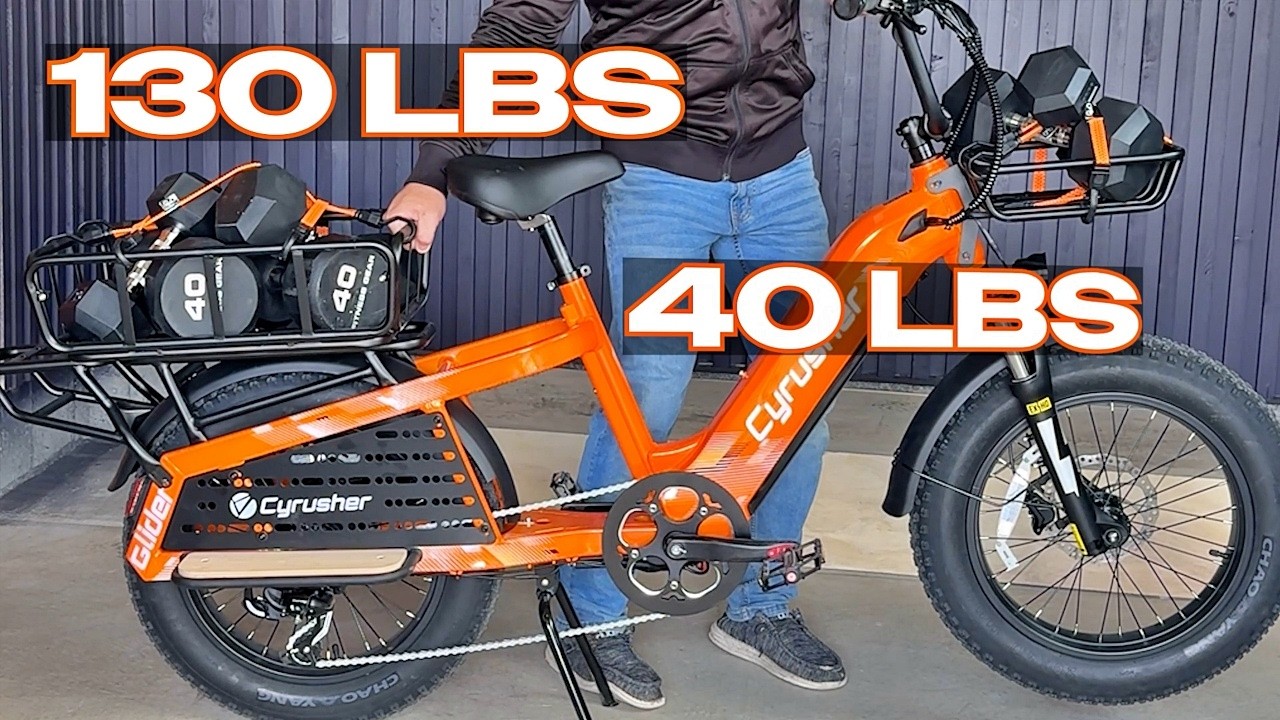
To truly test the hauling capabilities, I loaded the Glider with 170 pounds of my wife's gym weights—130 pounds strapped to the rear rack and 40 pounds loaded up in the front basket. Right off the line, the acceleration honestly surprised me; it took off as if I wasn't carrying anything at all. I pointed it up a 10% grade hill near my house, and it effortlessly averaged 11 mph with all that extra weight. Later, when I took it to my standard 15% grade test hill with just my 180-pound body, it proved to be one of the faster bikes I've ever tested on that incline in this class.
When it comes to top speed, things got a bit frustrating for me. Cyrusher rates this bike for up to 28 mph, but because it uses a torque sensor, you have to put in real physical effort to unlock that speed. With my normal pedaling cadence of about 70 RPM, the motor only pushed me to 18 mph. To actually hit 29 mph, I had to pedal my legs as fast as they could possibly go, leaving me completely out of breath after just a few blocks. I personally hate having to pedal above my normal RPM just to top out a bike.
I also noticed a significant stability issue during my cargo test. When carrying that 170-pound load and riding over 10 mph, the whole bike started to wobble in a pulsating motion. I could stop the wiggle by gripping the handlebars much tighter, but on a long trip, your hands are going to get incredibly tired. I really think if the designers had added a crossbar for a second point of contact from the front to the rear, it would have eliminated that wobble entirely.
Finally, for my range test, I took it out for 10 miles with 1,000 feet of elevation gain using exclusively the throttle at 18 to 19 mph. By the time I returned home, the battery had dropped by two bars. To get anywhere near the brand's claimed 62 miles of range, you will absolutely need to stay on flat roads and ride much slower than I did.
Design & Build Quality
The Cyrusher Glider has a striking, brightly colored frame with a beautiful glossy finish, but it is undeniably bulky in person. As I inspected the frame from top to bottom, I noticed quite a few prominent welding scars underneath the saddle and near the rear rack mounts; basically, anywhere they put two pieces of metal together, the welds are quite visible rather than smoothed out.
The massive saddle itself isn't my favorite. It looks big and accommodating, but I found it to be pretty hard and unforgiving for longer rides. The bike also comes with two rearview mirrors mounted to the BMX-style handlebars, but I wouldn't get too excited about them. They feel very flimsy, and the left mirror actually fell right off the bike during my off-road test.
On the positive side, it features mid-level hydraulic brakes that provide excellent stopping power. Even with 170 pounds of iron weights strapped to the racks, I had zero issues coming to a quick, controlled stop. The sturdy plastic fenders feel much better than the super cheap ones I often see, and the dual kickstand is an absolute must-have for stability if you plan to load up heavy gear or put little ones on the back.
Key Features
The bike is powered by a 750W rear hub motor that puts out 80 Nm of torque. That motor pairs with a basic thumb throttle on the right side that feels beautifully poppy and torquey—exactly the kind of responsive throttle I like to see on a heavy e-bike. The power delivery is controlled via a color LCD screen on the handlebars, which includes an advanced P-menu accessed by holding the plus and minus buttons, allowing you to limit top speeds and tweak internal settings.
It utilizes a torque sensor for pedal assist, which measures how hard you are pressing on the pedals. While that specific tuning made top street speeds difficult to reach, it actually makes the Glider fantastic for off-road riding because the power delivery is highly intuitive. It is paired with Choayang all-terrain tires, giving you decent grip on unpaved trails.
For cargo flexibility, the rear rack is highly adaptable. By removing just four bolts, it folds down, and an included accessory piece extends the rack out an additional four inches. It also features dual tail lights on both sides of the frame that illuminate whenever you pull either brake lever, giving you double the visibility from the rear, plus a bright headlight mounted securely under the front basket.
Who It's For
I'd point riders who want an absolute pack mule toward the Cyrusher Glider. If you fit comfortably between 4 foot 11 and 6 foot 3 and need an electric bike that can handle massive grocery runs, heavy work gear, or kids with its massive 440-pound capacity, the low-end torque and hauling power here are completely top-notch.
Who Should Skip It
If you're looking for a nimble, lightweight commuter, or if you prefer to effortlessly cruise at 28 mph without pedaling frantically, you should absolutely skip it. The intense 91-pound base weight, the speed wobble under load, and the demanding top-speed cadence make it far less ideal for casual, fast-paced street cruising.
How It Stacks Up
Because the Cyrusher Glider weighs 91 pounds, it has about 15 pounds more dead weight to carry than your standard fat-tire e-bike in this segment. This extra bulk could easily slow a bike down, but the Glider compensates incredibly well in the motor department.
Most competing utility e-bikes in this exact same class are hitting around 70 Nm of torque, whereas this model offers 80 Nm. As we all know from elementary school physics, more torque equals better pulling power for hills. That extra punch allows this extremely heavy bike to keep pace with—or even outclimb—its lighter competitors on steep grades, making it a standout for pure heavy-duty hauling.
Final Verdict
The Cyrusher Glider is a heavy, bulky machine with a few quirks like a speed wobble under heavy load and an exhausting cadence requirement for maximum speeds. But if your main goal is moving extreme amounts of weight up steep hills, the massive torque, rock-solid hydraulic brakes, and intuitive off-road handling make it a highly capable cargo hauler.
How much weight can the Cyrusher Glider carry?
The total riding capacity of the Cyrusher Glider is 440 lbs. In my testing, it easily handled my 180-pound frame along with an extra 170 pounds of gym weights.
How fast does the Cyrusher Glider go?
Cyrusher claims it has a speed rating of up to 28 mph. In my testing, throttle-only riding tops out at 20 mph, and reaching 28 mph on pedal assist required me to pedal extremely fast.
Is the Cyrusher Glider good for riding up hills?
Yes, thanks to its 80 Nm of torque, it is great for hills. I tested it on a 10% grade while carrying 170 lbs of weights and it averaged 11 mph, and it easily tackled a 15% grade with just my body weight.
How far can you ride the Cyrusher Glider on a single charge?
The brand states you can get up to 62 miles when fully charged. During my throttle-only test with 1,000 feet of elevation gain, I rode 10 miles and lost two battery bars, so you'll need to ride slower on flat roads to maximize range.
Does the Cyrusher Glider have suspension?
It features a front suspension fork that you can lock out. However, in my off-road testing, the preload adjustment didn't do much and it was pretty easy to bottom out the suspension.