
Lectric XPress Lite
I tested the new Lectric XPress Lite e-bike, and despite having a much smaller motor and battery than the popular Xpress 2, it still hits an impressive 29 mph on flat ground.
- Hit 29 mph on flat ground in Turbo pedal assist mode on a full charge
- Sheds nearly 15 lbs of weight compared to the Xpress 2, making it highly maneuverable
- Advanced display settings allow you to seamlessly swap between torque and cadence sensors
- Managed nearly 15 miles of range in Turbo mode while climbing over 1,500 feet of elevation
- Tail light is conveniently tucked under the saddle and flares brightly when braking
- Massive drop in top speed (from 29 mph down to 11 mph) when the battery hit 20%
- Acceleration off the line is cut in half when the battery runs low
- No front suspension fork means the ride gets incredibly bumpy off-road
- Noticeable welding scars are left visible on the frame, head tube, and rigid fork
- Top Speed
- 29 miles per hour
- Range
- 45 mi
- Charge Time
- 4 hours
- Motor
- 33% smaller than the Express 2
- Battery
- 44% smaller than the Express 2
- Brakes
- hydraulic brakes with a 180 mm rotor
- Gearing
- 8-speed Shimano shifter
Lectric XPress Lite
Amazon · Check current price · As an affiliate we may earn from qualifying purchases.
Overview
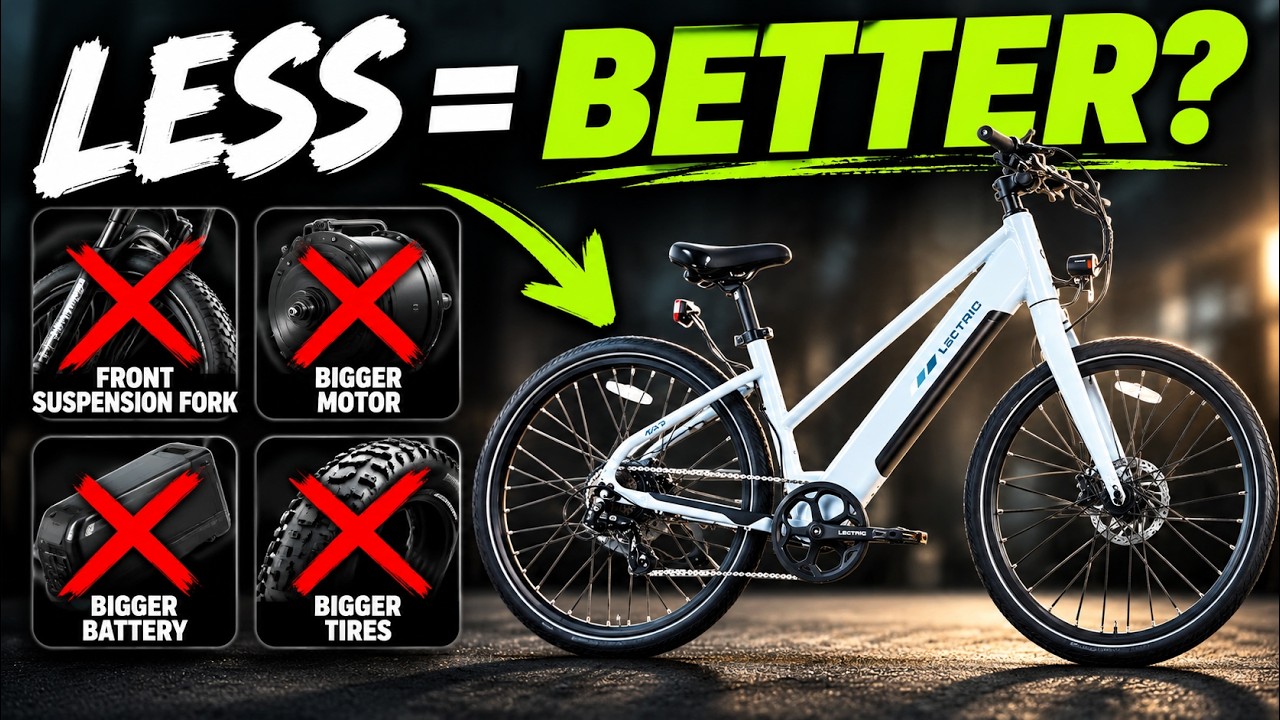
Lectric, arguably the biggest e-bike company in the US, recently launched a brand-new model called the XPress Lite. They essentially took their most popular commuter bike—the Xpress 2—and stripped it down. They put a smaller motor on it, swapped in a smaller battery, narrowed the tires, and completely removed the front fork suspension. As a reviewer who rides every new commuter that hits the market, I was highly skeptical. Why take a winning formula and remove key parts?
The result is a streamlined commuter bike that sheds a lot of bulk while attempting to keep the core riding experience totally intact. Coming in at 300 bucks less than the standard Xpress 2, this Lite model is clearly designed to give you more bang for your buck. I put it through my rigorous testing loops, taking it on steep hills, off-road trails, and long flat straightaways, to see if Lectric actually made a better bike by taking some features away.
Real-World Performance
In my flat ground speed tests, the genius of this downsized design really came to shine. Using the throttle alone, I easily topped out at 20 mph. When I switched to pedaling and set the bike to the highest pedal assist mode—Turbo—I consistently hit between 28 and 29 mph on a full charge. This is wild because the motor is 33% smaller than the one on the Xpress 2, yet both bikes have the exact same speed rating. I also took it to a brutally steep 50% grade hill. I honestly expected a much slower speed on an incline that sharp, but my average speed was a surprisingly capable 8 mph.
However, I noticed a substantial drop in performance as the battery drained. A guy like me wonders how fast an e-bike will actually go when the battery is low. So, I drove around until the battery hit 20%, went back to the exact same spot, and ran another speed test on the same stretch of road with the same pedal cadence in first gear. My top speed plummeted from 29 mph down to just 11 mph. That is a massive loss of 18 miles per hour. E-bikes always lose speed as the battery drains, but this was a substantial amount. The good news is I didn't sense any drop in power or speed until the battery dipped to about 25%. Also, acceleration off the line changes dramatically; at 100%, I hit 20 mph in less than a city block, but at low battery, acceleration was half as fast.
For my range test, I skipped the slow Eco mode—it's too boring and slow for my taste—and cranked the bike up to Turbo mode. Weighing in at 180 lbs, I maintained an average speed of 25 mph and tackled over 1,500 feet of total elevation gain. Even under those highly demanding conditions, I got almost 15 miles of total range. Those are very good stats for Turbo mode on a battery this small.
Design & Build Quality
By shrinking the battery by 44% and reducing the motor size, Lectric made this bike almost 15 lbs lighter than the Xpress 2. Having less weight to haul around makes a huge difference in how the bike handles on paved trails and roads. It feels incredibly smooth and stable. There's no annoying rattling, no shaking, and the motor is pleasantly quiet. The posture puts a comfortable, slight bend in my back without forcing me straight up and down, which is perfect for a commuter bike.
Since they removed the front suspension fork, things do get bumpier when you leave the pavement. I took it off-road for about a mile and a half at roughly 10 mph. While it's definitely doable if you need to cut across a field, this rigid setup is really meant for paved trail and street riding. Comfort is helped slightly by a basic Lectric seat with suspension underneath, which kept me from feeling sore in any places during my longer range tests.
Aesthetically, the bike features a nice glossy paint job and cleanly grouped wiring up front. You will, however, notice visible welding scars on the frame, the head tube, and the rigid fork. Down at the drivetrain, it includes quick-release pedals, which are handy, and an 8-speed Shimano shifter. The handlebars are raised up a couple of inches and feature high-quality lock-on grips that don't twist or slide around. For the overall riding feel, I confidently give it an 8 out of 10.
Key Features
The control pad offers five distinct speed modes: Eco, Tour, Sport, Sport Plus, and Turbo. But if you hold the plus and minus buttons down, you unlock an advanced settings menu that really lets you customize the ride. You can swap the bike's classification between Class 1, Class 2, Class 3, or a specific California class. I kept it set to Class 3 for my entire review to maximize the top speed.
In those same advanced settings, you can toggle the pedal sensor from torque to cadence depending on your riding preference. You can also adjust the assistance level with a standard torque multiplier or an increased torque multiplier for more raw power. Additionally, you can limit the throttle output to match your current pedal assist level, though I chose to allow full throttle output across all assist levels. There's even an option to choose between a zero-start throttle or one that waits until the bike actually moves before the power kicks in.
The battery itself is UL certified, which gives excellent peace of mind, and it fully charges from empty in just 4 hours. Braking is confidently handled by hydraulic brakes paired with a 180 mm rotor, which provided reliable stopping power during my downhill tests. I also really appreciated the taillight tucked underneath the saddle that flares up brightly whenever you hit the brake lever.
Who It's For
I'd highly recommend the Lectric XPress Lite to budget-conscious commuters who stick mostly to paved roads, bike paths, and city streets. If you want Class 3 speeds, a highly customizable digital display, and a surprisingly capable hill climber but don't want to haul around a heavy frame, this is a fantastic, lightweight option.
Who Should Skip It
If you regularly commute long distances where you'll dip below a 25% battery charge, you should look elsewhere, as the speed drop-off at low battery is severe. I'd also tell off-road riders or those navigating heavily potholed streets to skip it, as the lack of a front suspension fork makes for a much bumpier, rigid ride.
How It Stacks Up
Compared directly to the Lectric Xpress 2, the Lite is a strategic downgrade that saves you significant money and weight. The Xpress 2 has a motor that is 33% larger and a battery that is 44% bigger, giving it a longer 60-mile Eco range rating versus the Lite's 45-mile rating. The Xpress 2 also includes front fork suspension and thicker tires. However, because the Lite sheds almost 15 lbs of weight, it manages to match the Xpress 2's top speeds of 20 mph on throttle and 29 mph on pedal assist, provided the battery is topped off.
Final Verdict
The Lectric XPress Lite proves you don't necessarily need a massive, heavy motor and a giant battery to achieve great commuter speeds. While it certainly struggles to maintain top speed when the battery gets low and lacks front suspension for rougher terrain, the lighter weight and highly customizable display make it an absolute joy to ride on smooth pavement. At 300 bucks less than its heavier sibling, it's a smart, capable buy for city riders looking to save some cash without sacrificing top-end performance.
How fast does the Lectric XPress Lite go?
When fully charged and set to Turbo pedal assist mode, the Lectric XPress Lite can reach top speeds between 28 and 29 mph.
What is the range of the Lectric XPress Lite?
It has a stated range rating of 45 miles in Eco mode. In my testing on Turbo mode with 1,500 feet of elevation gain, I achieved roughly 15 miles per charge.
Does the Lectric XPress Lite have front suspension?
No, it features a rigid front fork to save weight and reduce cost, though it does have a basic seat with suspension underneath.
How long does the Lectric XPress Lite take to charge?
The UL certified battery takes exactly 4 hours to fully charge from empty.
Does the Lectric XPress Lite lose speed when the battery is low?
Yes, I experienced a severe power drop-off. Once the battery hit 20%, my top speed dropped from 29 mph down to just 11 mph.