
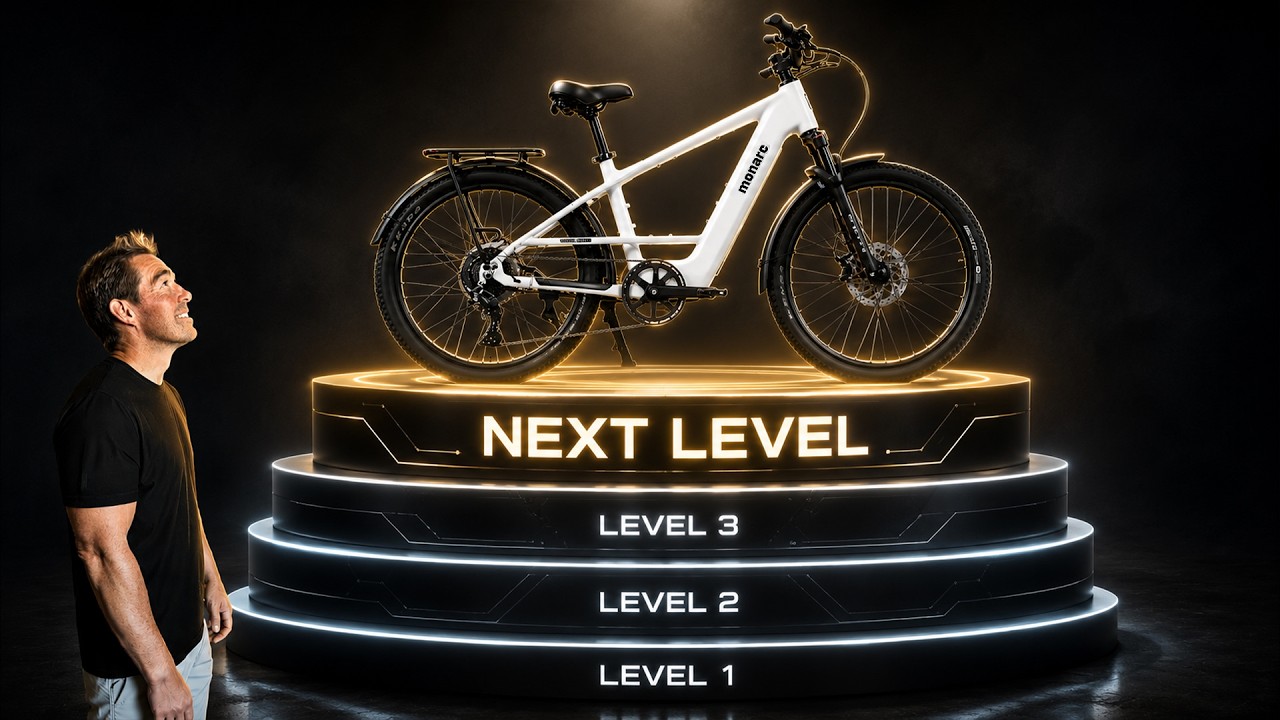
Monarc Tracer
The Monarc Tracer combines an aggressively punchy 750W motor with dual batteries right out of the box, offering one of the most customizable commuting experiences I've ever tested.
- Lifted the front wheel off the line in Boost mode thanks to immediate torque-sensor response.
- Breezed up a steep 20% gradient hill holding 7 to 10 mph using only the throttle.
- Brought me to a halt from 35 mph in under 40 feet with its powerful Star Union hydraulic brakes.
- Includes two 48V 15Ah batteries standard for a combined estimated range of roughly 120 miles.
- Absorbed sidewalk transitions and curb drops very smoothly thanks to the reverse front fork.
- Fishtailed slightly when I slammed the brakes hard at 35 mph.
- Off-road performance is bumpy; I had to slow down below 10 mph to handle ruts safely.
- Takes roughly half a second for the motor to re-engage after letting off the throttle.
- The dedicated mobile companion app wasn't available during my test riding.
- Motor
- 750 W
- Battery
- 48 volt, 15 amp hour (x2)
- Top Speed
- 29 mph
- Weight
- 71 lb
- Payload
- 420 lbs
- Charge Time
- 3 hours
- Brakes
- Star union brakes (203 mm front, 180 mm rear)
- Tires
- Kenda Krad tires
- Warranty
- 5year warranty
Monarc Tracer
Amazon · $35 · As an affiliate we may earn from qualifying purchases.
Overview
The Monarc Tracer is an entirely new commuter e-bike from a fresh brand launched by the owners of Lectric Ebikes. Lectric is already an absolute giant in the US e-bike market, and with the Tracer, they are clearly taking commuter bikes to a whole new level. Not only does this e-bike bring a sleek, modern aesthetic, but it also bundles premium features practically unheard of in its bracket.
What immediately caught my attention is that the bike ships standard with two separate 48V 15Ah batteries utilizing LG cells. Throw in a heavy-duty 420-pound payload capacity and an incredible 5-year warranty, and it’s obvious Monarc wants to aggressively capture the everyday commuter market.
While I don't have the exact MSRP, it's priced competitively with other mid-level e-bikes while offering roughly double the battery capacity. If you're looking for an electric bike that won't die on long routes and can carry plenty of cargo, this model demands a look.
Real-World Performance
To see what the 750W motor could really do, I took it straight to an asphalt straightaway. I'm a 180-pound rider. With the bike in Boost mode and set to gear one on the torque sensor, the immediate power actually popped my front wheel off the ground. I laid into the pedals and rocketed to 28 mph in just one standard city block. Later, in a throttle-only test, I hit 20 mph in about a third of a block.
Next, I tackled a 20% hill grade using exclusively the throttle to see if the motor would bog down. It hit the bottom at 10 mph and never dropped below 7 mph during the absolute steepest section. For range, I rode heavily for about 43 minutes, covering 19 miles and 1,100 feet of elevation gain while averaging nearly 25 mph. I came home with 18% battery remaining on a single pack, which means getting roughly 60 miles per battery at high speeds is highly realistic.
For stopping power, I took the bike up to 35 mph and slammed the brakes. The Star Union hydraulic disc brakes bit hard, bringing me to a complete dead stop in just under 40 feet. My back end did fishtail a little bit at that extreme braking pressure, but the control was still good overall.
Design & Build Quality
For a dual-battery commuter, the Monarc Tracer hits the scales at a reasonable 71 pounds. The step-through frame feels solid, and it features a really unique bottom structural piece with no visible welds up by the head tube. It’s also covered in mounting points for water bottles and extra gear.
I really enjoyed the riding posture. You get a riser in the stem combined with BMX-style handlebars, leaving my back perfectly straight and perfectly comfortable. The large commuter saddle has dedicated suspension underneath that soaked up the ride well, and overall, I never felt strained during my testing.
In the front, Monarc used a reverse (inverted) suspension fork to increase traction and comfort. When I hopped off curbs, it provided one of the softest pavement landings I've experienced on a commuter bike. However, when I transitioned onto rougher off-road trails, the Kenda Krad gravel tires and suspension got way too bouncy at 20 mph. I had to back my speed down to 10 mph to keep the bike manageable over rocks and ruts.
Key Features
One of the biggest standouts in my testing was the beautifully integrated touchscreen display. It's incredibly deep yet intuitive. By poking around the menus, I was able to manually adjust the bike between Class 1, 2, or 3, change the throttle from matching the pedal assist level to a flat high output, and literally toggle the motor's behavior between a torque sensor and a cadence sensor depending on how I wanted to ride.
On the hardware side, you get bolted-on wing tip grips, quick release pedals, and a sturdy rear rack rated to hold 60 pounds. There is a 9-speed trigger-style shifter tied to a Shimano CUES derailleur, giving you plenty of gearing flexibility to keep up with the motor at 28 mph.
Safety is a huge focus on the Tracer, too. The display activates turn signals, and holding a button down near the tail light kicks on fully functioning hazard lights. While the companion mobile app wasn’t available during my ride, the screen indicates the bike is ready to pair with future accessories like front and rear TPMS sensors, heart rate monitors, and smart helmets.
Who It's For
I’d point daily super-commuters who face long stretches of road toward the Monarc Tracer. If you want insanely snappy acceleration, massive cargo capacity, and the peace of mind that comes with carrying a robust dual-battery setup, this is an absolutely killer choice that practically guarantees you won't be hit with range anxiety.
Who Should Skip It
If you're hunting for a dedicated off-road machine or an aggressive trail e-bike, skip it. The inverted fork and Kenda tires handle beautifully on tarmac and curbs, but they bounce around far too much if you try to bomb rural trails at speed.
How It Stacks Up
When positioned against the broader segment of mid-level commuter e-bikes, the Monarc Tracer separates itself through sheer value and customizability. Most competitors in this bracket force you to choose between cadence or torque sensors and rarely provide a touchscreen interface that lets you dynamically alter individual pedal-assist power curves. Bundling a second premium LG cell battery right out of the box makes it a serious outlier in an industry that normally charges steep premiums for range extension.
Final Verdict
The Monarc Tracer delivers a top speed of 29 mph, punchy torque, confidence-inspiring hydraulic brakes, and roughly 120 miles of range. By wrapping these features into a comfortable frame backed by a 5-year warranty for the same price as most mid-level single-battery e-bikes, Monarc has created an instant winner for serious pavement commuters.
How fast does the Monarc Tracer go?
In my testing, the Monarc Tracer can hit a top speed of 29 mph when unlocked to Class 3 in Boost mode.
Does the Monarc Tracer come with two batteries?
Yes, it includes two 48V 15Ah batteries right out of the box, giving it up to a combined 120 miles of range.
Is the Monarc Tracer good for hills?
Absolutely. I tested it on a steep 20% block using only the throttle, and it easily held 7 to 10 mph all the way over the top.
Does the Monarc Tracer use a torque or cadence sensor?
It actually has both. You can use the touchscreen display to instantly switch between a torque sensor or a cadence sensor based on your preference.
What is the weight limit on the Monarc Tracer?
The bike can support a hefty total payload of 420 lbs, and the built-in rear rack is rated to hold up to 60 lbs of that limit.