
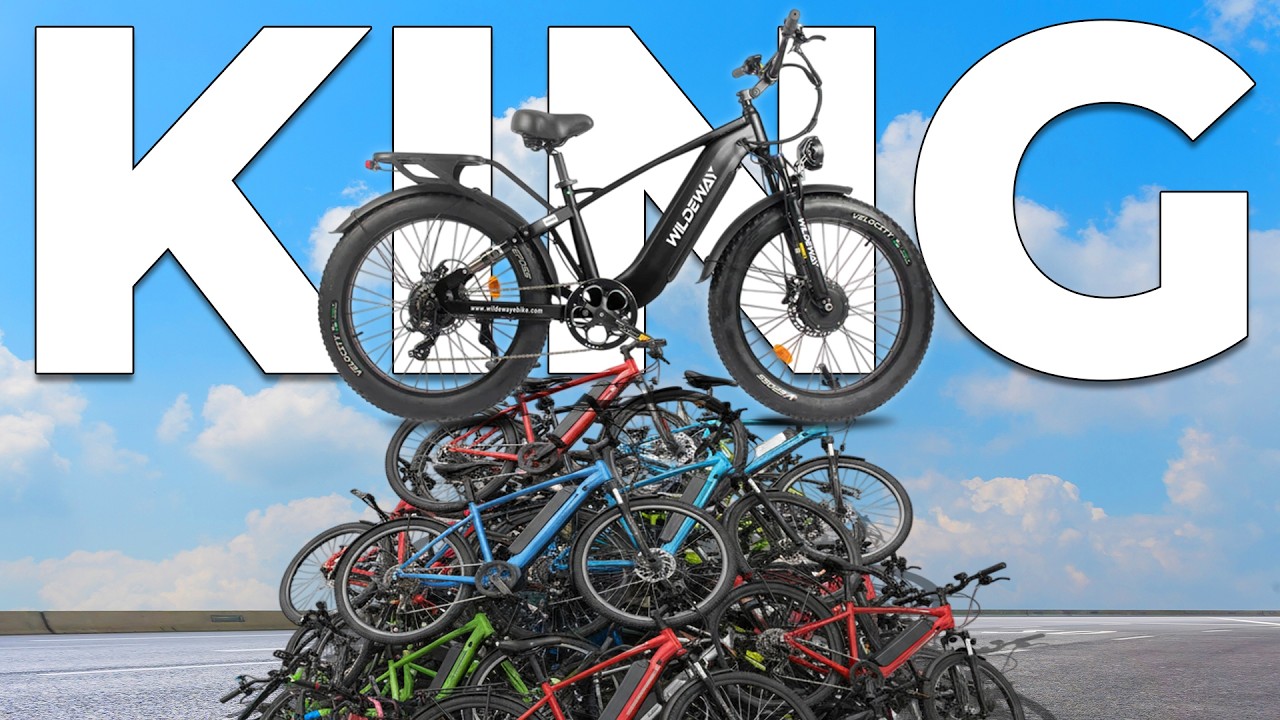
Wildeway Soared E-Bike
I pitted the $1,300 Wildeway Soared against top brands like Rad Power and Lectric, and its dual 750W motors and 33 mph top speed absolutely dominated the competition.
- Hit 33 mph in my top-speed test, exceeding its official 32 mph rating.
- Conquered my 15-percent grade test hill at 13 mph from a dead stop using throttle only.
- Features dual 750W motors you can easily toggle via the LCD display.
- Beefy hydraulic brakes with 203 mm rotors stop the heavy 106-pound frame quickly.
- Rear rack handles a massive 100-pound payload, beating out higher-priced competitors.
- Weighs a massive 106 lbs, making it incredibly heavy and cumbersome to move manually.
- Sizing is off; I am 5-foot-11 and can barely stand over the mid-step frame.
- The bulky rear rack caught my leg multiple times when I tried to dismount.
- The overall ride and feel isn't as refined or smooth as competitors like Lectric or Rad Power.
- The rear suspension is technically present but extremely basic in its performance.
- Motors
- 750 in the front, 750 in the rear
- Battery Capacity
- 1,440 watt-hours
- Weight
- 106 lbs
- Carrying Capacity
- 440 lbs
- Rack Carrying Capacity
- 100-pound
- Top Speed Rating
- 32 mph
- Range Rating
- 75 miles
- Brakes
- hydraulic brakes with a huge 203 mm rotor
- Derailleur
- Tourney derailleur
- Shifter
- SIS index Shimano shifter
- Rider Size
- 5'4' to 6'4'
- Water Resistance
- IPX65
- Warranty
- one-year warranty
- MSRP
- $1,300
Wildeway Soared E
Amazon · Check current price · As an affiliate we may earn from qualifying purchases.
Overview
I recently had AI run a performance test based on the stats of the two most popular electric bikes sold in the US, and then I pitted them directly against the Wildeway Soared. What I found during this deep dive really surprised me. This bike from Wildeway absolutely dominated the competition in raw specifications. It beat out giants like Rad Power Bikes and Lectric in energy density, power-to-weight ratio, and load efficiency.
You would naturally think a bike that dominates in performance is going to cost a lot more money. But that simply isn't the case here. The Wildeway Soared costs just $1,300. For that price, you are getting two motors—a 750W in the front and a 750W in the rear—while the mainstream competitors typically only give you one.
It also comes equipped with full suspension, featuring a front fork and dual rear shocks on the left and right sides. It seems almost too good to be true on paper. Over the years, I have reviewed plenty of popular models, and while I have no complaints about them, they've got some serious competition with this release. Now, I am not saying the Wildeway Soared is the perfect bike, but as far as raw performance for the price, this thing kicks butt.
Real-World Performance
The performance numbers you probably care about most are speed and range. Wildeway gives this bike a massive range rating of 75 miles. To test that, I did a real-world range test going full throttle with both motors engaged. I averaged about 30 mph, and by the time I got back home after 13.36 miles, I still had two battery bars left on the display. It is a big drop from the 75-mile rating, but what they don't tell you is that maximum range is only achievable if you just use a single motor.
Next, I wanted to see what it could do in terms of speed and acceleration. The bike has a top speed rating of 32 mph, but during my testing on flat ground, I actually hit 33 mph. I absolutely love an e-bike that costs $1,300 and hits over 30 mph. When it came to acceleration, it picked up power incredibly fast. I hit 20 mph in probably 100 feet, which did not take long at all.
For hill climbing ability, I took it up to a local hill that I test all my electric bikes on. It is a steep 15-percent grade, which is a great benchmark for motor torque. I started at the bottom without any momentum, relying purely on the throttle. By the time I reached the top, I was holding steady at 13 mph. Getting a 106-pound bike up a hill that steep at that speed is just flat-out impressive.
Design & Build Quality
Let's dive into the physical footprint, because this is where I have to talk about a few things that I definitely didn't like. First and foremost is the pure, humongous size of this bike. I am a 5-foot-11 guy, and even though this is marketed as a mid-step frame, I can barely stand over it. Wildeway claims a rider size of 5-foot-4 to 6-foot-4, but shorter riders are going to struggle mightily with the stand-over height.
The weight is also a massive factor. At 106 lbs, this is an incredibly heavy machine. The rear rack is so big and bulky that I actually hit my shin on the back end of it when getting off the bike, which may have caused some inappropriate words to escape my mouth. As for the overall ride and feel, it is just not as nice or refined as some of its competitors. I like it, but it lacks that premium polish.
Visually, it has a mean, tough vibe. The weld job is exactly what you would expect for a bike in this price range, meaning you will see a bunch of welding scars up near the headset, underneath the saddle, and on the rear fork. The rear rack is also fully welded to the frame. It comes equipped with stiff, thick plastic fenders, a basic Tourney derailleur, and standard SIS index Shimano shifters.
Key Features
Despite the budget price, Wildeway packed in some great features. To unlock the bike's full potential, you can easily toggle between the dual motors using the LCD display. You just hold down the 'i' button on the control pad until the rear wheel icon flashes, hold it again for the front wheel, and hold it one more time to engage both. It is simple, but you definitely don't want to forget to turn both on, or you will miss out on a lot of power.
I was also really impressed by the brakes. Given how heavy this bike is, I was a bit worried, but Wildeway included beefy hydraulic brakes paired with huge 203 mm rotors. The braking performance is genuinely fantastic for a 106-pound beast. They did a very good job putting proper stopping power on this frame.
The bike features adjustable handlebars. By loosening an Allen bolt, you can adjust the angle from +30 to -30 degrees. I pulled them up for a more upright riding posture, but you can push them down for an aggressive off-road stance. Other notable specs include an IPX65 water-resistant rating, a huge soft saddle with its own suspension, and Samsung batteries that carry UL 2849 and UL 2271 safety certifications.
Who It's For
I'd recommend the Wildeway Soared to budget-conscious speed demons and heavy-payload riders who want maximum power without breaking the bank. If you routinely tackle steep hills or need to carry heavy gear on a rear rack, the dual motors and massive load capacity make this an absolute powerhouse for the price.
Who Should Skip It
If you're looking for a highly refined, smooth-riding commuter or you have limited storage space, skip this model entirely. Riders on the shorter side will also want to avoid it, as the heavy frame and tall stand-over height make it extremely cumbersome to mount and maneuver safely.
How It Stacks Up
I explicitly compared this bike against two heavyweights in the budget e-bike category: the Rad Power Bikes RadRover 6 Plus (priced at $1,400) and the Lectric XPeak 2 (priced at $1,500). When it comes to energy density—which is my fancy way of calculating range by dividing battery capacity by bike weight—the Wildeway dominates. With its massive 1,440 watt-hour battery and 106-pound frame, it yields 13.6 watt-hours per pound. For comparison, the 73-pound Rad Power only manages 9.2 watt-hours per pound, while the lighter 67-pound Lectric manages 10 watt-hours per pound.
In terms of power-to-weight, the dual 750-watt motors give the Wildeway a combined 1500 watts. Dividing that by its 106-pound weight gives you 14.2 watts per pound. The single-motor Rad Power sits at 10.3 watts per pound, and the Lectric sits at 11.2 watts per pound. This translates directly into my top-speed tests, where the Rad topped out at 20 mph, the Lectric hit 28 mph while pedaling, and the Wildeway easily blasted past them to 33 mph.
Finally, looking at payload efficiency, the Wildeway has a staggering total carrying capacity of 440 lbs, meaning it can carry 4.2 times its own weight. However, the number that actually matters for real-world cargo is the rear rack capacity. The Wildeway rack holds a massive 100 lbs, completely outclassing the Rad at 50 lbs and the Lectric at 60 lbs. Where the competition wins, however, is overall ride feel—both the Lectric and Rad Power offer a significantly more refined and polished riding experience.
Final Verdict
If you are looking for a fat-tire e-bike for $1,500 or less, I think it is safe to say that the Wildeway Soared is the option I would go with if you prioritize speed, range, and raw power. For just $1,300, you get an absurd amount of capability and dual-motor performance that other popular brands simply can't match at this price point.
It is incredibly big, extremely heavy, and a little rough around the edges in terms of refinement. But if you want to go fast, tackle steep hills, and carry heavy loads while spending less than the competition, the pure value here is undeniable.
How fast does the Wildeway Soared e-bike go?
It has a top speed rating of 32 mph. During my real-world testing, I was able to hit 33 mph on flat ground.
What is the range of the Wildeway Soared?
Wildeway rates the bike for 75 miles if you only use one motor. In my test using full throttle and both motors at 30 mph, I went 13.36 miles and still had two battery bars left.
Is the Wildeway Soared good for climbing hills?
Yes, it is excellent on hills. I took it up a 15-percent grade hill from a dead stop using only the throttle, and it reached 13 mph by the time I hit the top.
How much weight can the Wildeway Soared carry?
The bike has a massive overall carrying capacity of 440 lbs. The rear rack specifically is rated to hold up to 100 pounds of cargo.
How heavy is the Wildeway Soared e-bike?
The bike weighs 106 lbs, which makes it significantly heavier than many other e-bikes in its price class.