
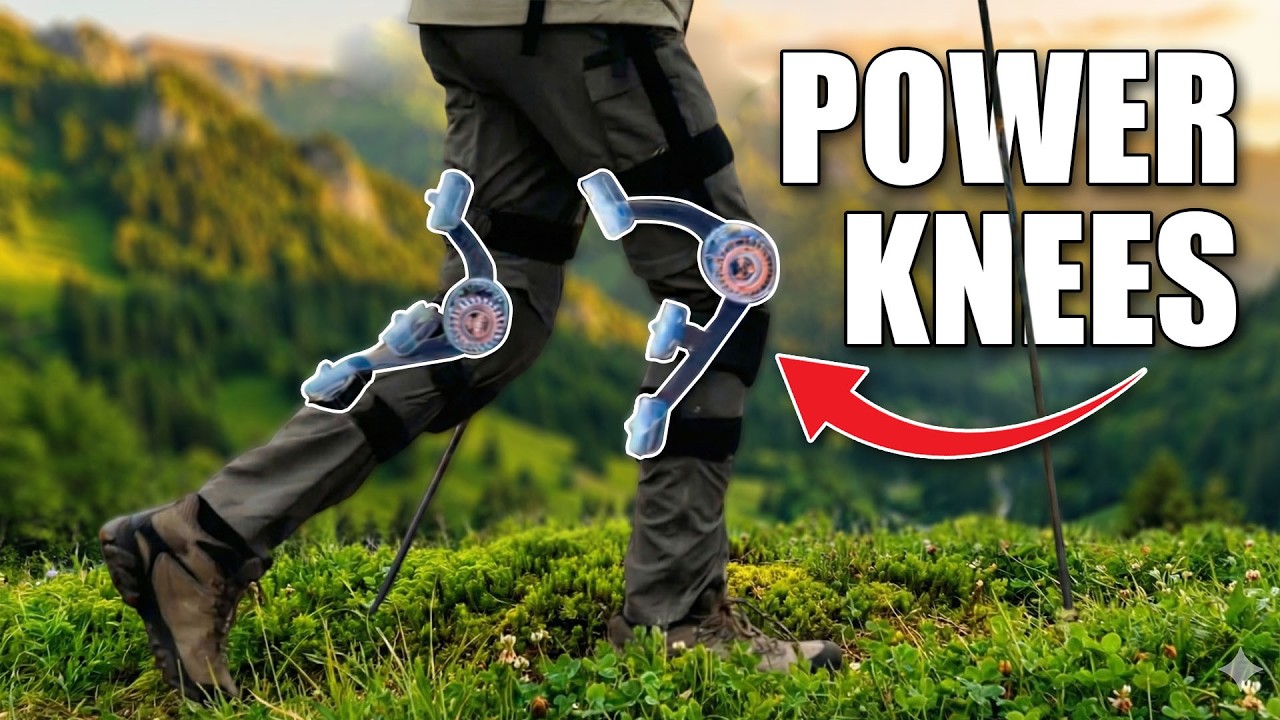
WIRobotics PowrKnee
The WIRobotics PowrKnee is a lightweight exoskeleton that gives your legs superhuman strength, turning 15% grade hikes into a breeze while easing the pain of bad knees.
- Rockets you up stairs and steep hills with immense power on level four.
- Motor reaction time is incredibly fast on off-road terrain and divots.
- Tension automatically releases when sitting down for a few seconds.
- Swappable batteries can be removed and replaced like a gunslinger while wearing the device.
- Helped my friend's sister-in-law successfully climb stairs despite muscular dystrophy.
- Bulky battery banks press against you and make sitting in a car uncomfortable.
- Weighs your pants down enough that wearing a belt is an absolute necessity.
- Thick thigh pads make your legs quite sweaty after a couple of hours.
- Taking them off leaves you with 'jello legs', similar to stepping off a cruise ship.
- Battery Life / Runtime
- Up to 5 hours
- Charge Time
- 3 to 4 hours
- Climbing Range
- Up to 8,200 ft on a single charge
- Waist Fit
- 28 to 48 in
- Height Fit
- 5'1 to 6'4
- Thigh Fit
- 15 to 26 in
- Calf Fit
- 14 to 19 in
- Weight Limit
- 110 to 265 lb
- IP Rating
- IP54
- Warranty
- 1 year
WIRobotics PowrKnee
Amazon · Check current price · As an affiliate we may earn from qualifying purchases.
Overview
I recently tested what I can only describe as magic legs. This is the PowrKnee from WIRobotics, and it is a lightweight exoskeleton designed to wrap around your legs and give power to your knees. If you have bad knees, this device aims to help with walking, running, hiking, sitting, and essentially any activity where you bend your knees. The assist comes from motorized pads positioned under your thighs that lift and push you forward as you move.
Going into this, I was skeptical about how much actual assistance a consumer exoskeleton could provide. I've tested a lot of outdoor gear, but strapping robotic motors to my legs is a new frontier. The PowrKnee currently has early bird pricing set at $1,499 for the Ultra model and $999 for the Pro model.
I spent a few days wearing these everywhere—from climbing steep off-road trails and running through the weeds to carrying heavy pumpkins and even pedaling a heavy e-bike. I also wanted to see if they could genuinely help someone with a medical mobility issue, so I tested them on my friend's sister-in-law, who struggles with muscular dystrophy. What I found completely changed my perspective on wearable mobility tech.
Real-World Performance
To really push the PowrKnee, I took it straight to a hill with about a 15% grade. I initially set it to Auto mode, which dynamically adjusts the power as needed. When you bend down and stand back up, you feel a distinct boost pushing you upward. I felt like I was walking up the hill with immense speed, though it doesn't do all the work for you. I was still out of breath by the top, but it was noticeably less taxing on my knees.
Wanting more power, I switched the app to level four—the highest mode. The difference was staggering. Slogging up the tallest, steepest hill I could find, the motors absolutely boosted me. Interestingly, I found that the slower I went, the more power the exoskeleton delivered. Coming back down the hill, the device puts pressure on a different part of the strap, right below the calf muscle. It actively kicks your foot out for you, ensuring you land with a straighter leg, which takes a massive amount of pressure off your bent knees.
Beyond hiking, I put the PowrKnee through a gauntlet of household chores. I carried a heavy pumpkin and immediately felt the assistance taking the strain off my legs. I also hopped onto my 90 lb e-bike, left the electric power off, and relied purely on my robotic knees to pedal. It took a heave to get going, but once I shifted into gear one and two, the exoskeleton actively gave me power as my knees bent. It didn't do the pedaling for me, but it undeniably helped me move a heavy, dead e-bike down the road.
Design & Build Quality
Walking around with the PowrKnee is an experience. You have over a pound of hardware strapped to each leg, plus the battery banks which add roughly another 2 to 3 lb. Because of this, it weighs your pants down significantly. I quickly learned that you absolutely must wear a belt when using this device.
While the straps are secure, the thick pads under your thighs do trap heat. After wearing the suit for a couple of hours, my waist and legs got quite sweaty, especially in the back. I also hopped into the driver's seat of my car to see if I could comfortably commute while wearing them. Unfortunately, the rear-mounted batteries are bulky and push you out of the seat, making driving rather uncomfortable.
One of the most bizarre physical sensations happened when I finally took the exoskeleton off. I didn't realize how much of the load the device was carrying while I walked. Once I unstrapped them, my legs felt incredibly weak. I had intense 'jello legs', much like the wobbly feeling you get when you step off a cruise ship and feel like the ground is still moving.
Key Features
The PowrKnee is packed with functional tech, starting with its companion app. The app walks you through a step-by-step process for strapping the device on, which is vital because you need everything perfectly aligned. It features an Auto mode, but you can manually dial the assistance up to level four. When I took it off-road onto a dirt trail, the reaction time of the motor was insane. Its sensors are incredibly sensitive, instantly changing and reacting to tiny divots or ruts in the road.
It also features an unexpected leg-locking mechanism. When I stopped walking and just stood flat on the trail, the device helped straighten my legs out, locking them in place. It reminded me of how a horse locks its legs to sleep, and it noticeably relieved pressure. I could stand like that for hours. If I had these back when I was working road shows for Blendtec in Costcos, my life would have been vastly different.
The device isn't just for assistance; it also features a massage mode and a workout mode. The massage mode isn't a deep-tissue rub, but it provides a nice vibration that moves your legs and feels quite relaxing. The workout mode, however, is brutal. It reverses the polarity to add resistance. It felt like I was wearing 15 lb weights on each leg. I was deep-breathing before I even made it halfway up the hill. If you want to make your daily walk miserable, this mode is for you, but I personally hated it.
Who It's For
I highly recommend the PowrKnee for anyone with bad knees, older hikers who want to reclaim the stamina they had in their twenties, or people who have a genuinely tough time getting around. To test its medical viability, I had my friend's sister-in-law, who has muscular dystrophy, try it. She normally has to carefully plan when she goes up and down her stairs because she can't do it alone. After stumbling slightly on the first few practice steps while getting used to the unnatural feeling of power assist, she confidently cruised up and down the staircase entirely on her own. It completely changed her day.
Who Should Skip It
If you are looking for a stealthy device that you can hide underneath your pants so nobody knows you're wearing it, skip this. The bulky battery packs and thick thigh straps are very visible. It's also not ideal for playing fast-paced competitive sports, as the bulk and weight will definitely get in your way.
How It Stacks Up
The consumer exoskeleton market is still in its infancy. Traditionally, this kind of motorized leg assistance was strictly relegated to medical rehabilitation clinics or military applications, costing tens of thousands of dollars. Bringing this level of active, responsive motor torque to a consumer device that you can just strap on at the trailhead is a massive leap forward. While we don't have many direct consumer rivals to compare it to yet, the fact that it actively reacts to off-road divots puts it far ahead of passive knee braces or simple spring-loaded sleeves.
Final Verdict
I was not expecting this exoskeleton to work nearly as well as it did. The WIRobotics PowrKnee delivers genuine, palpable power that pushes you up steep hills, catches your weight on the way down, and gives a massive boost when climbing stairs. At the early bird price of $999 for the Pro and $1,499 for the Ultra, it is a significant investment. But if you have bad knees or mobility issues that are keeping you from enjoying life outdoors, these magic legs are absolutely worth it.
How long does the WIRobotics PowrKnee battery last?
The company claims it can last up to 5 hours and climb up to 8,200 feet on a single charge.
How long does the PowrKnee take to charge?
It takes around 3 to 4 hours for a full charge, and you can charge both battery banks at the same time.
Is the WIRobotics PowrKnee waterproof?
The device has an IP54 rating, which means it is protected against dust and light water splashes, but it shouldn't be submerged.
Does the PowrKnee have different sizes?
It is designed to fit a variety of shapes and sizes, accommodating heights from 5'1 to 6'4, waists from 28 to 48 inches, and weights from 110 to 265 pounds.
Can you use the WIRobotics PowrKnee to work out?
Yes, it features a workout mode that adds heavy resistance. In my testing, it felt like wearing 15-pound weights on each leg and left me completely out of breath.